How to Run a Group Session: Don't Let the Community Get in the Way of the Individual
What changes when there is more than one person on the floor? Daniel Persson and Brandon Gallagher on ratios, reading the room, and why community is your job.
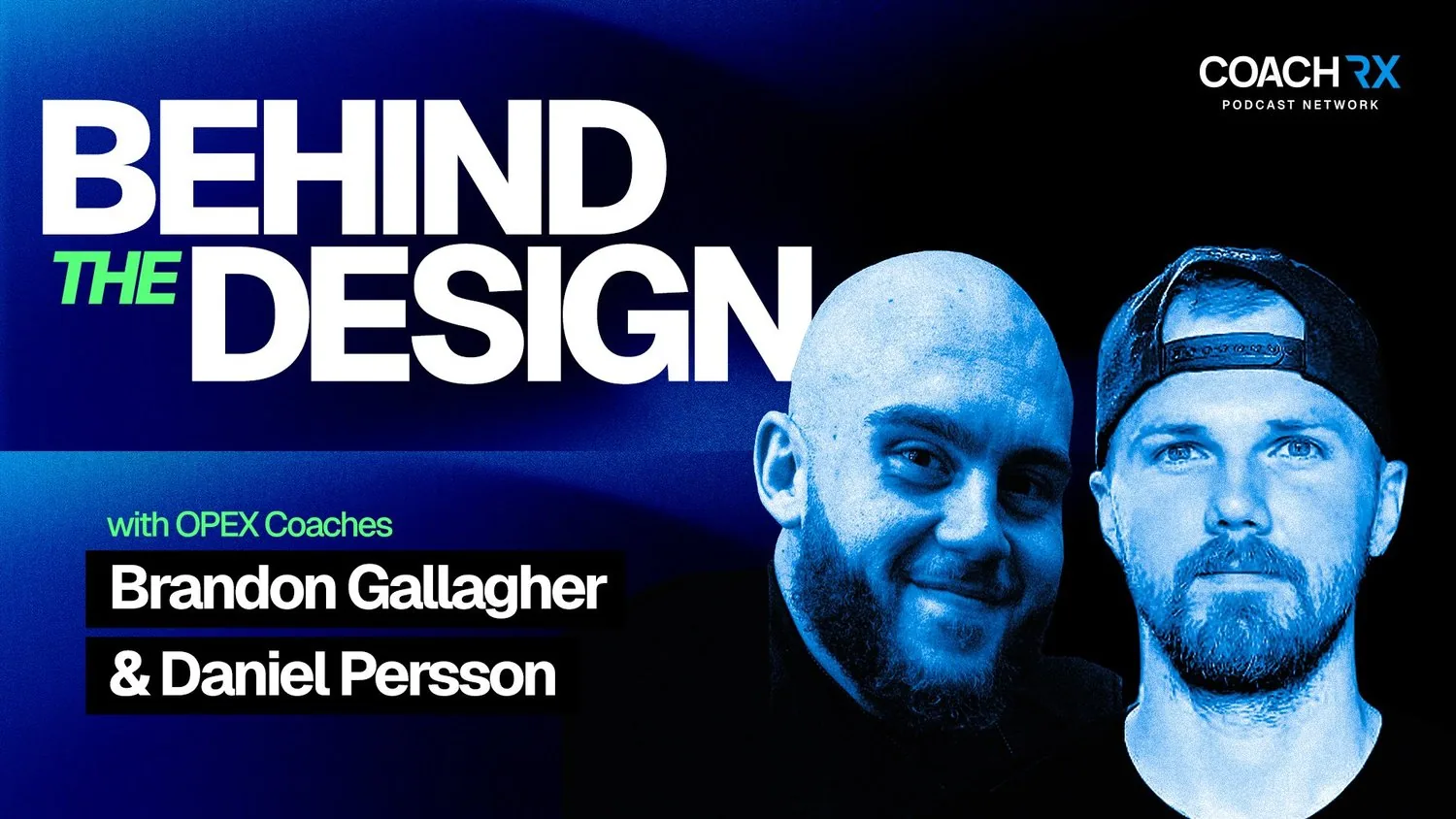
Behind the Design, Episode 41 with OPEX Coaches Daniel Persson and Brandon Gallagher
What changes when there is more than one person on the floor? Not the energy, and not the preparation. Daniel Persson and Brandon Gallagher would tell you those are the same whether one client walks in or six. What changes is what is being asked of you. The eyes, the cues, the conversations, the personalities, the clock, and a community that either gets built on purpose or gets built around you whether you like it or not.
This is the second episode in a short series on in-person coaching. Last week was the one-on-one personal training session, door to debrief. This week is the group session, which Brandon defined loosely as anything with more than one person in the room, and which both hosts know from the inside. Brandon ran his first gym on a small group personal training model and coached groups almost exclusively until 2023, when he switched to personal training and individualized remote coaching. Daniel's group experience comes from running gyms, including CrossFit gyms, where he built a hybrid model that kept individual design at the center and used the group as one of its tools. Both of them like group coaching. Both of them also think most of it is done badly, and the reason is usually the same. The community gets treated as the product, and the coaching quietly stops being taken seriously.
Kandace opened the episode with two notes. The new CoachRx website went live the night before, after a build that started in February. And the October cohort of the OPEX Method is in week three, with enrollment open for 2027. Brandon, who is in the cohort, said it has been good to be back in it, and that being around newer coaches has sent him home with questions about his own practice.

What Counts as a Group
Brandon started by sorting the terms, because the industry stretches them. Small group personal training is usually two to four people, maybe six. Small group training gets applied to classes of twenty, which he said does not make any sense. At his first gym, Thrive, small group personal training ran up to twelve people a class, and if twelve people showed up there were two coaches on the floor. A one to six ratio, at most, per coach. That was the balance they found between giving an individualized service and getting past the ceiling of a single session, where you can only really train one person. Beyond that is large group training, twelve, fifteen, twenty plus, which he was clear is not ideal for what he considers real, individualized fitness, because it is very hard to manage on the floor.
Daniel described the spectrum from the other direction. The gyms he ran offered full individual design, complementary training, or group classes only, which is really a question of how individualized a given member needed to be. But he reframed it for himself over time. The product and the service is individual design. Program design is a tool inside it. Sometimes a group class is also a tool inside it. He still coaches clients that way now: he designs four out of five training days, and on Saturday they do a team workout, have fun, and take part in the community. Members at his gym went through consults and the full individual design process, and some of it was blended into group training. His rule throughout was to not let the group, or the average, get in the way of seeing the individual.
The Community Is Your Job
The idea Daniel kept returning to came from how he trained his own coaching team. When he defined the role, the question underneath it was how a small gym competes with bigger ones that have every structural advantage. The answer came down to two things. The quality of the coaching, if it was better than the average on offer in large group classes. And the community. And his argument is that people talk about community as if it exists on its own, or as if it is a thing that gets in the way of being professional. He thinks it can be handled professionally, and that coaches are responsible for all the interactive structures that go on inside the building.
The obvious part is coach to client. Know the names of every member. Ask them questions. Be present. Care. The part he thinks coaches miss is client to client. If one member loves hockey and another member loves hockey and they have not interacted yet, it is the coach's job to connect them, to pull both into a conversation about something they can keep talking about later. That is where he thinks on-site coaching and the group setting are at their most powerful, and it is the thing he comes back to whenever he talks about the craft of coaching on the floor.
Brandon agreed that group coaching is, for the most part, about community. Not because the programming does not matter, but because of why people are there. They come to work out with other people, make friends, and use the energy of the room. The people who do not need that energy are either training on their own or gravitating to personal training. So the outside of the session, what he called the crust after baking a sourdough the day before, looks a lot like a PT session. You want energy when one person walks in and you want it when six do. He has always found it easier with more people in the room, because you can pull conversations off, bring a quiet person in, bounce between people. One of his first mentors did this, badly, by turning to someone silent and saying, what do you think. The method was clumsy and the instinct was right.
The contrast he drew is simple. Walk into a room where six people are flat and you think, this is miserable, why would I train here. Walk into a room where six people are fist bumping you by name and you feel like you are somewhere you are wanted. That is what drives the environment, and if you can build it, you will have a very strong gym. It also sells itself. Get a few people seeing real results into the same room and have a new person walk in, and that is a sale waiting to happen. The energy is there and the people are there. The coach's job is to facilitate it and point it in the right direction.
A few mechanics follow. Leave your own stuff at the door, as covered last week. Check in with everyone at the start, not for a life story, just to get the vibes going for the day. Say people's names, because with multiple people in the room you want each one to feel heard and seen, but do not overdo it to the point where it feels like a technique. And do the work before anyone arrives. Most gyms have a sign-up system now, so you know exactly who is coming. Check the schedule, set up the equipment, make the adjustments any individual needs, and have it ready. The way Brandon prepares for and starts a group session is the same as a PT session. The only difference is the number of people in front of him.
Where Community Goes Wrong
Both hosts were blunt about the failure mode. Community can keep people in a gym where the training is poor, or the business is poorly run, because nobody gets challenged in the right way. You get the member who says, I do not really like it, but all my friends train here and I do not want to leave them, so I will stick it out. Not terrible, not great.
Daniel finds it sad. He sees gyms that are excellent at building community and then, if you look at the quality of the coaching, it is not to the standard he tries to hold in the profession. His example: Eric is quite good at Olympic weightlifting, so does Eric want to run a weightlifting class. First, that is going from no education to running a class. Second, being good at weightlifting does not mean you are good at coaching weightlifting. That is where gyms get stuck. Community is the only thing they push, they get a bit lazy about the craft, and they end up with a strong community that is not creating actual value for the clients. He thinks it is also part of what keeps coaches from making it full time, because it devalues the role of a coach, which is the opposite of what this profession should be doing.
He has struggled with it personally. When he is inside one of those communities, he fights the urge to send someone a link. And after running his first gym he made himself a promise: if he ever did it again, he would not let the community get in the way of professional relationships or of running the business professionally. The craft of coaching and the community are two separate responsibilities, and the second does not excuse the first.
The Individualized Group Session
Which brought them to the version of group training both of them believe in, and which Brandon said not many people run yet. The common model is a workout on the board, everyone does roughly the same thing, and the coach adjusts here and there. The newer model is that every person who walks in has their own plan, and the group is the setting for it.
At Brandon's first gym, every member had their own strength program. The class warmed up together, broke out for thirty to forty minutes of individualized strength work, and came back together for fifteen to twenty minutes of something everyone could do side by side: assault bike, rower, a cyclical piece, or some mixed modal work. The strength work needs to be individual. The finish, for that demographic, was the place to come together and push through to the end. The whole thing fit in an hour, with five to ten minutes of warm-up up front, and the hardest part was that people move at different speeds and some take longer to build to a heavy weight.
He contrasted it with the Orangetheory and F45 model, packing people like sardines into a room with a couple of cheerleaders, putting them through the ringer, and calling it small group training. It builds community, and plenty of people happily go through it. But for coaches who love program design and want to build something specific for each person, there is a better way to run a group that still feeds that desire and still gives people the room full of people they came for.
Daniel's version at the CrossFit gym he took over for the second time was to rebuild the calendar on OPEX principles. The classic CrossFit style workouts stayed, but the week was organized around sustain and gain, sessions of sustainable work and sessions of strength or resistance work, with the strength days built as full body resistance sessions. Then, in monthly or quarterly consultations, each member sat down and asked what they needed, and built their own best version of the calendar from it. A hybrid, even for people only doing classes. And individual design sat alongside it in every gym he ran, CrossFit gyms included.
How Many People Is Too Many
Brandon asked for the number. Daniel's threshold is six. Up to six you can be more present. Past six it gets different and it comes down to structure. With ten people on the floor for an hour you have to be careful about how you spend your time in the room. Keep moving. Do not get stuck with one member for fifteen minutes, because the rest of the room needs some of your presence too. Past ten or twelve, if your ambition is to give technical feedback on every movement, be present, and ask each person something non-training related, it is really tough. If you believe in individualized training and want to keep an eye on everything, more than ten is very hard work.
Brandon landed in the same place from the gym side. Twelve was the limit at Thrive with two coaches, so six to a coach. If your systems are tight, you have been doing it a while, and the people on the floor are experienced enough to spot someone on occasion, you could probably push to fifteen, because at a certain number it becomes something like training with a partner. But twelve is the magic number, six per coach, because it is hard to bounce between that many people, make sure everyone is taken care of, tweak what needs tweaking, and keep an eye on every single person inside the hour.
Daniel's gym ran it slightly differently. A traditional class was an hour devoted to one thing, a strength session with warm-up and briefing, or a sustainable work session, or the classic CrossFit structure of strength then conditioning. Alongside that was a bookable open gym, which he treated as its own product. Members could book floor time to do their individual design, and because he practically lived at the gym, he could see in the system who had booked, come down, speak to them, look at a lift, and make sure they had what they needed. That was a bonus, not a priced service. Remote coaching and on-site coaching cost the same, and nobody was promised a set amount of floor time. He also noted that you can go the other way and make bookable floor coaching part of the service, where being in the gym with your individual design client is what they pay for.
Brandon wanted the open gym model at his gym and his business partner at the time was not on board. He still thinks it is one of the best environments for a certain person: someone with a strong desire for individualized training who just wants to be around people. Training is a social piece for a lot of people now. At the same time, the fixed class, show up at six and be done at seven, gives structure to people who need it, because left alone some people will wander for an hour and a half. The point is that both exist for a reason, and the coach being there, available but not on top of you, is the thing people value in the open gym.
Managing the Floor
Once you are inside a twelve person session, Brandon said, you have to be very efficient. Cues have to be clear and short, and sometimes they are delivered from across the room. You are watching the whole floor at once. That person is fine. That person is not going to hurt themselves. That person might, let me get over there. You do not get caught sitting in one spot with one person. And you get good at conversations on the fly, knowing what you want to talk about with each person as you move, because you are driving conversation with multiple people while checking on person one, then person two, in a flow that keeps the class running.
Daniel added a detail he treated as small and clearly was not. When he was coaching three people through a movement, he made sure one of them was at the far end of the room. If he gave a cue to someone at the end of the room, not shouting, just clearly, everyone felt that he was looking everywhere and present all the time. Coaches who only ever coach the person directly in front of them are vulnerable, because the rest of the room notices how present you are. The same logic applies to wins. If a member smashed a back squat PR, he told the whole class of six or eight, everyone clapped, and the room opened up to interaction. It was both coaching and delivery: not only what the cue is, but whether people feel watched, and whether he could multiply himself across the room.
Brandon's version of multiplying yourself is the experienced members. Not coaching for you, but people you have taught well enough that they extend your reach, which frees you for the people who need more attention. And that raised the opposite problem. Some people need more of you than others, and you do not want to neglect the people who do not. So early in the session, he would go to the self-sufficient member and say it plainly: I know you are good, I know what we have for you today, I am over here if you have questions, I will keep stopping by. Then that person does their thing, and he watches from a distance.
Twelve Personalities and One Coach
This was the part of the episode where Brandon admitted something coaches rarely say out loud. Group coaching, done right, is probably one of the most exhausting things in the job. You go from someone who just hit a PR to someone crying to someone who is angry to someone who is the happiest they have ever been, in the same hour, and then the session ends and the next one is walking in. If you are not used to managing your own emotions, it will wreck you.
His answer is to keep yourself at a level. In personal training it is easy and often right to match the client's energy. Someone walks in happy, you go with it. In a group you cannot do that, because if you ride the high with one person and then walk over to someone who is crying, you are in the wrong place. So you find yourself in between all of it, and you do the work early to bring everyone up to a baseline. That is what the huddle, the pre-talk, the breakdown, whatever you call it, is for. It prepares people to have a good session. Plenty of people walk in off the worst day of their week and lighten up a little because they know the next hour will be better.
Daniel's tool for the same problem is the neutral question. His members were used to him asking, how did you feel, with no lead in it, because he did not want to color their experience. Say great job, how did you feel, and you have already told them the right answer. Asked neutrally, the question also told him where they were. If someone came back a bit down, he could meet them there. If they were hyped, he could go with it. It gave him the chance to figure out how someone actually felt before he decided how to coach them, and on a floor with eight people that is the information you need.
Brandon added the between-session layer. Even in the group setting he was adamant about checking in during the week. How did that feel, any questions, anything that needs adjusting. And at the gym, pre-COVID, every member had a binder. They walked in, grabbed it, found the week's program printed on a sheet, tracked their notes on it, and put it back, and the coaches updated it every week. It was messy and it ate space and the recyclists hated them. It was also something that felt like theirs. Their name on it, their information in it, waiting for them when they walked in. Between a coach who greets you, a coach who is ready for you, and a thing that is yours, you have most of what it takes to bring the energy of a room up and get someone excited to train.
He also told the story of the group client he misses most, who answered every how did you feel with I do not know. He would do a squat, Brandon would ask where he felt it, and the man would say, I do not know, I just do what you tell me and hopefully it works. Paid in cash, never had a cell phone, possibly lied about his name. If you are out there, Brandon said, you were one of his favorites. The question is still the right question.
Ending on the Dot
Both hosts described the same feeling at the end of a good group session and neither tried to make it sound professional. For Brandon, personal training is very fulfilling, but there is something special about running a group class and ending it on the dot. Everyone is happy, everyone leaves excited, everyone crushed it, or you look up at the clock and realize without planning it that the hour landed perfectly. It is a skill in itself. Personal training is more efficient and effective for getting an individual to a goal. Group training, done right, asks so much more of the coach that it becomes a different expression of coaching.
For Daniel, the thing he misses most about running a gym is Friday afternoon. Six to eight people booked into an open gym capped at eight, all on their individual designs, laughing, the weekend almost here. He took pride in being able to switch on and off: look at this lift with full attention, then joke about something, then back to the lift. Being in that room with people having fun and expressing fitness, and having the skill to coach well inside it, is by far the moment he misses most.
Which is why Brandon was careful about who group coaching tends to attract. It often gets adopted by cheerleader coaches, high energy, not always technically sound, who can get away with it in a group because the rest of the gym's structure covers for them. But group coaching can be very effective in the hands of a coach who holds the principles this show is built on, believes in individualized coaching, and can carry that into a room full of people who came for each other's energy. That coach gives people the group they wanted and the plan they needed.
One Coach, One Client, One Community
Daniel closed with a phrase OPEX used to push: one coach, one client, one community. Group classes may be a great way to get people into fitness. The goal is still autonomy and individualized design. And the community does not have to get in the way of you seeing the individual. You can take responsibility, as a professional, for the community you build around your clients, and at the same time make sure every one of them gets to experience their ideal version of fitness. Brandon's framing was that if you run these sessions with a real rhythm, a real structure, and a framework you follow to the letter, you are setting up something bigger than a good class, which is where next week picks up.
Where to Go From Here
Next week closes the series with the transition they have both been building toward: how to move someone from an in-person client, group or personal training, into a remote client, and how to teach someone to be a better remote client. If you are a group coach with questions about implementing any of this, or you just want to run a better session, PT or group, Brandon and Daniel both offered to go over it with you on Instagram. Both have experience helping gyms with the training side.
The idea underneath this episode, that the program is a tool and the coach is responsible for the whole experience around it, is the work taught inside the OPEX Method Mentorship, where Brandon is in week three of the October cohort. Enrollment is open for 2027, which runs as two semesters, with the first live cohort starting in February. Daniel's note for anyone deciding: the program has a large digital component, and you are assigned your mentor as soon as you onboard, so starting now means you begin with your mentor and arrive well ahead of the live cohort. The page is linked in the description. Apply and book a call with a coaching advisor, who is a graduate of the program rather than a sales rep, to explore it.
Behind the Design releases weekly on the CoachRx Podcast Network, and every episode is in a playlist on the OPEX YouTube channel if you want to catch up on the series from Episode 40.
The new CoachRx website is live, and the platform is about to get busier: quick demo linking just shipped, group chat is close, with programs that auto-add clients to their chats, and Workout Builder V2 is nearly ready. Start your free 14-day CoachRx trial and bring principled programming, habit tracking, and high-touch communication all in one seamless coaching command center.
For the full pathway into this kind of program design, look at the OPEX Method Mentorship.
Connect with the coaches
-
Brandon Gallagher: Brandon's Instagram (@bgperform_)
-
Daniel Persson: Daniel's Instagram (@danielcapersson)
Join us live on Tuesdays mornings 11:30am EST on the OPEX YouTube Channel

More in Frameworks.
Deliver the coaching
you're capable of.
Try CoachRx free and see what changes when every part of your practice is in the same place.