OPtimum EXperience Behavior
Exercise and nutrition are mostly solved. Behavior is about 3% in. Carl and James close the OPtimum EXperience series on the part a machine cannot coach yet.
Frameworks with Carl Hardwick | CoachRx Podcast Network
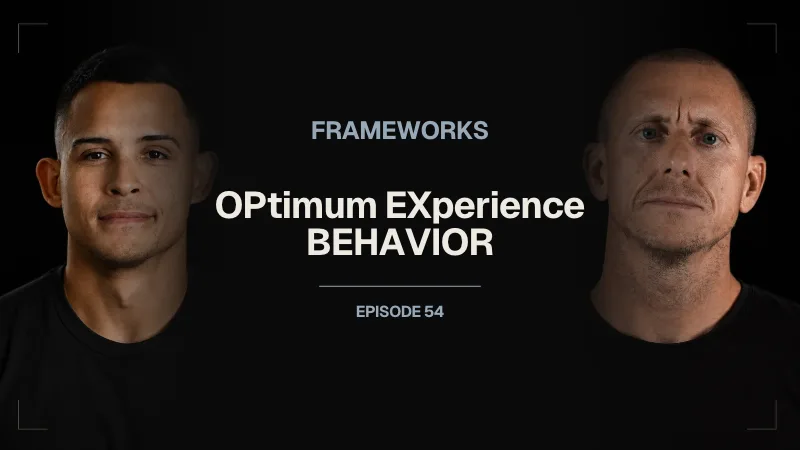
Frameworks, Episode 54, with Carl Hardwick and James FitzGerald
Notes from Frameworks Episode 54, the final conversation in the OPtimum EXperience series with Carl Hardwick and James FitzGerald.
Can a Machine Coach Behavior?
Three weeks ago Carl and James set out to answer one question in three parts: what is a person's optimum experience in exercise, in nutrition, and in behavior? Exercise came first. The conclusion was simple enough to fit on a plate: do not train so hard in your garage that you cannot hold a conversation with your kids for three hours afterward. Nutrition came second, and James would now shorten his answer to five words. Just eat real food. And then, in his words, shut up.
Behavior does not shorten that easily. That is the whole episode.
The through line is awareness
Carl opened with the awareness ladder. Unconscious incompetence, conscious incompetence, conscious competence, unconscious competence. James did not invent it, but Carl first heard it from him, and it sat underneath last week's nutrition tiers without either of them naming it. The point of the ladder, in James's framing, is that awareness and capability rise together. The more aware you become, the more capable you become, and the two feed each other.
Carl's question was whether the top rung is the aim for behavior. Is the goal to be unconsciously competent in how you live, to the point where you can say "this is just how I live now"?
James would not give a clean yes. Who judges competence when the subject is a well-behaved human? He named where he lands personally, sovereignty, agency, autonomy, privacy, individualism, and acknowledged that those values would not be everyone's. That honesty set the terms for the rest of the conversation. They were not going to hand down a protocol. They were going to wrestle with principles.
One sentence on the table
James's rule for behavior is three words: learn new things.
He chose it because it sounds vanilla. Dig in and it is not. Learning new things means admitting you do not know. It means you are consistently in search of an answer, which James calls the truest definition of the capital-S scientific process. There are no answers through science, only more questions and further investigation. It also forces a pause: where am I in my life, and have I calcified in how I think and how I act? Are the things I learn every day the things that are calcifying me?
That is why the word is new, not known. Known things are written down and defended. New means possibilities.
Carl pushed on it. What is actually wrong with calcifying? James's answer: you stop opening yourself to the progression of time. You start to think you have the answers. We think we know a lot today, the same way people thought they knew a lot in 1492. The practice he recommends is to hold what you know in your pocket and then go read the critique of it. He does this with his own faith, reading both the apologetics and the criticism, because a person who truly believes they already have the truth cannot sit around a fire with friends or have a deep, empathetic conversation with anyone who sees it differently.
Why behavior is different
Carl asked the question most coaches would ask. Does the investigation ever end? If you are convinced eating real food is good for you, do you still have to go read the rebuttals?
James's answer drew the line that organizes the whole series. In the coaching world, exercise and nutrition are about 98% done. The knowledge is innate; people have it in them. Broccoli was broccoli fifty years ago and it is broccoli now, no matter what the latest video says about soil depletion. You could spend twenty years studying that and find a fraction of a percent of difference.
Behavior is maybe 3% in. And it is not 3% in because the field is lazy. It is 3% in because the ground is moving. Humans evolve. Technology has matured, in Nick Bostrom's sense, faster than our sense of how to live inside it. A twelve-year-old girl in a digital world is not a twelve-year-old girl from fifty years ago. Nutrition has metabolics and macronutrients. Exercise has motor control and strength endurance. Those are tangibles with ends. Behavior involves what makes us tick, why we do things, motivations, and things deeper than motivation. There are no resolutes there yet.
Can a machine coach behavior?
Carl put the question directly. Technology can already build a good program design and a good nutrition prescription with the right context, and it can do both better than a human right now. So can a machine coach behavior?
James: it can, and it will.
His reasoning is uncomfortable. The phone is already teaching a generation how to behave. People learn how other people act in the world through a screen. He does not call it social media. He calls it fantasy media, because it is not social. It is parasocial. People think they know him because they watched him on a Zoom call. They have not eaten breakfast at his house, done kayak intervals with him, or hunted with him. They do not know him. The machine has convinced them the relationship is real.
So yes, a machine will tell people how to behave. It already does. The question is whether coaches help people learn from something better.
Where new things actually come from
James offered two sources. Real experience, and real books.
Real experience is how humans have always built what he calls the soft code of how to behave, through communion and connection with one another. His example was a weekend hunting elk in the Idaho panhandle. He walks a lot. The specificity of that terrain did not carry over from walking, and it will not carry over from watching someone else do it on YouTube. You have to do it.
Real books means the actual texts, in hand, sat with. When gender ideology became a cultural fault line in the early 2010s, he went back and read the major texts and their history before he felt entitled to an opinion. Not articles. Not threads. The book.
Carl raised the obvious problem: there is a lot of trash out there, and plenty of books are fantasy too. James's answer was not to read less. Read broadly, then balance it against Real experience, capital R. He can read every book on the feminine perspective and still speak at a higher level only because he has two daughters, a wife, two sisters, and a career full of female clients. The reading gives you the map. Real life tells you whether the map is any good.
By the end of the episode the rule had its subtext. Learn New things, capital N. Carl's version: learn new things, filter them through real life experience, and if you do not have the experiences, seek them. James accepted the amendment, with the complaint that it is going to be hard to fit on his table.
Lisa's ideal
Carl brought it back to Lisa, the client who has run through the whole series. What is her ideal version of behavior?
James gave two parts. Keep learning, and be kind. His phrasing in the moment was blunter, and he defended the bluntness: told plainly, it lands better than a poster that says be kind. Most adults, given a little time with the question, can tell the difference between kindness and its opposite. If you do not believe that, go test the extreme and see how it works out.
Can kindness be learned? Yes, and the method is the same. Real experience. When the stress gets high, truths are revealed. Bad guys do not finish first, whatever the pessimists say, if first means higher awareness, higher contentment, higher self-empathy, and more of the small-g good in the world.
Carl offered a definition he has used before: to be kind is to will the good of others. James did not argue with it. He added a point coaches may not expect. Kindness is less subjective than it sounds. Pool the whole planet and ask what kindness is, and the answer looks a lot like the human rights documents. They are old, they can be upgraded, and they are still the closest thing we have to a shared, objective baseline for how to treat other people.
What this means for coaches
James closed with a line borrowed from someone wiser: be open-minded, but don't let your brains fall out.
For a coach, the practical takeaway is not a new behavior-change protocol. It is a posture. Exercise and nutrition are mostly solved, and a machine can already handle a lot of the prescription. What a machine cannot yet do is give a client Real experience, or sit across from them while they test what they think they know against how their life is actually going. That is the 3%. That is where coaching the whole person actually lives.
Watch the full episode on the Frameworks YouTube channel, or listen wherever you get your podcasts.
Frameworks is part of the CoachRx Podcast Network. New episodes weekly.
Listen to Episode 54 Now
Watch on YouTube Listen on Spotify Catch up on past episodes + blog recaps
Have questions?
DM Carl on Instagram @hardwickcarl
Frameworks is part of the CoachRx Podcast Network, your hub for principled, purpose-driven coaching conversations.
For more shows, visit: coachrx.app/podcast-network
Stay ahead of the curve and provide the best for your clients with CoachRx.

More in Frameworks.
Deliver the coaching
you're capable of.
Try CoachRx free and see what changes when every part of your practice is in the same place.