

The Hidden Cost of Performance and Feeling Unwell
Your body composition can improve while your health moves in the opposite direction. Muscle mass may hold steady, body fat may drop, and training numbers may rise, yet energy, libido, and recovery can fall apart. That gap between objective results and lived experience sits at the center of the conversation between Carl Hardwick and James FitzGerald. Looking better doesn't always mean feeling better.
Higher Order Resilience: Finding the Right Dose of Stress
What if chasing fitness, tracking every metric, and avoiding discomfort are making you less resilient? In this episode of Higher Order Resilience, Carl Hardwick and James question what resilience really means, how stress helps us adapt, and why the right dose matters more than simply doing more. They discuss physical, cognitive, emotional, and behavioral resilience, along with the difference between a useful challenge and stress that leaves you broken down.

Your Fitness Tracker Is Killing Your Intuition
In this episode of Frameworks, Carl Hardwick and James FitzGerald discuss intuition. How a person builds real knowledge of their own body, why measurement so often erodes it, and where data still belongs if the goal is a client who eventually does not need it.
Maximal (Human) Potential
The conversation in fitness has always been about progressing. What do we give people that makes them better at things? James spent years handing individuals tools and learnings and watching them get better, and every one of those cases eventually produced the same set of questions. At what rate does this person improve? What is the timeline? How much room is actually left?
Those questions have answers. Not perfect ones, but real ones, and they hinge on two variables coaches often collapse into one: chronological age and training age. James built the chart as a base support, something that would force a coach to consider both every single time someone sat down in front of them, so the coach could figure out the general possibilities for that specific person.
The Death of the Craftsman
Tactician to craftsman to master: where the framework came from, what each stage actually feels like from the inside, and why the craftsman may be quietly disappearing from the fitness industry. Not because coaches stopped wanting to be good. Because the timeline required to get there no longer fits the culture we coach inside of.
Nutrition Truths: Eat Real Food, Then Give It Rhythm
Exercise no longer has to happen for most people. Modern life lets you work, travel, eat, and socialize with very little physical effort, which means fitness is now a choice that needs a reason.
Carl Hardwick and James FitzGerald frame that reason around more than appearance, workout scores, or proving toughness. The goal is to build awareness of what you can do, challenge yourself with purpose, and keep doing the things you care about for as long as possible.
Fitness Truths: Stress, Recovery, and Real Resilience
Exercise no longer has to happen for most people. Modern life lets you work, travel, eat, and socialize with very little physical effort, which means fitness is now a choice that needs a reason.
Carl Hardwick and James FitzGerald frame that reason around more than appearance, workout scores, or proving toughness. The goal is to build awareness of what you can do, challenge yourself with purpose, and keep doing the things you care about for as long as possible.
What Does Fitness Mean? A Personal Framework for Coaches
Fitness means nothing anymore if it can mean appearance, calorie burn, competition, performance, health, or a social media score all at once. Yet that does not make the idea useless. It means coaches and clients need a definition that fits the person, not a borrowed standard.
For Carl Hardwick and James FitzGerald, fitness is less about winning a test and more about building practices that support the life a person wants to live.
James Fitzgerald's Road to the 2007 CrossFit Games
When physical performance becomes your whole identity, an injury can leave you asking who you are without it. James Fitzgerald faced that question as a young athlete, then built a life in coaching, education, and competition that led to the first CrossFit Games title in 2007.
His story is not a straight line toward a championship. It includes years of rehabilitation, early coaching work, financial uncertainty, resistance from established fitness circles, and the pressure that came after winning.
Fitness Fallacies Part 2: Why Sustainable Habits Beat Fitness Quick Fixes
A dramatic workout, restrictive food rule, or fast weight-loss promise can feel productive because it offers certainty. Yet sustainable habits do more for long-term health than any single villain, trend, or six-week reset.
Carl Hardwick and James Fitzgerald argue for a simpler standard: challenge your body, eat real food often, and do the hard thinking required to understand your choices. That standard asks more of you, but it also gives you something that quick fixes can't, a way to keep going.
Fitness Fallacies: VO2 Max, HIIT, and Wearables
A fitness metric can be useful without becoming the purpose of your training. Trouble starts when a complicated idea gets packaged as the answer to a long, healthy life, better fitness, or personal health.
In a conversation between Carl Hardwick and James Fitzgerald, three popular claims get a hard look: VO2 max as a longevity predictor, high-intensity interval training as the most efficient path to fitness, and continuous glucose monitors for healthy people. The bigger issue is the same in each case: giving away your judgment to a score, a trend, or a device.
Physical Freedom Starts With What Your Body Can Do
The moment your body stops doing what your mind asks of it, life gets smaller. That can show up on a mountain trail, on the floor with your kids, or in a quiet moment when you want to kneel and can't. Physical freedom gives you a cleaner way to think about fitness. It asks a simpler question than most training plans do: can your body obey your will?
Fitness Autonomy and the Real Job of a Coach
Most coaching promises progress. Far less coaching asks the harder question: can the client keep going without you? On this episode of Frameworks, Hardwick and OPEX founder James Fitzgerald push that question to the center. Their point is simple, but it cuts against a lot of modern fitness: the goal of coaching should be autonomy, not dependence.
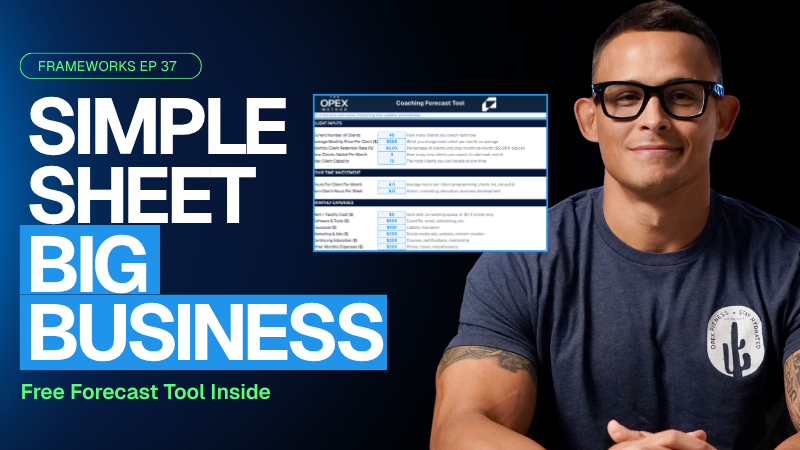
Why Most Fitness Coaches Go Broke (And How to Fix It)
Most fitness coaches don't fail because they're bad at coaching. They fail because the math behind their business doesn't work. In this episode of Frameworks, I break down why great coaches burn out, why common coaching models cap your income, and how to fix it before you waste years grinding for too little. I walk through real numbers for group coaching, personal training, and individual design, then show how I think about pricing, retention, capacity, and profit. If you're a fitness coach trying to build a sustainable coaching business, this one matters. I also walk through a simple forecasting tool so you can stop guessing, run your numbers, and make better business decisions with clarity.
Will AI Replace Fitness Coaches? The Real Answer
Fitness coaches keep asking me the same thing right now: will AI replace us? My answer is no, not if you're a great coach. But I also don't think we can ignore what's happening and hope our work stays the same.
Why Specializing Makes You a Better Coach (And Gets You Better Clients)
If you feel like you're doing all the right things but your message still isn't landing, you're not alone. A lot of coaches are "lost in this whole like marketing world," and the default answer becomes, "I coach everyone." In a crowded market, that approach makes it harder to coach well, harder to explain what you do, and harder for the right clients to trust you.
Specialization fixes that, not as a marketing trick, but as a coaching decision that improves your reps, your results, and your clarity. Carl Hardwick and Kandace Dickson (host of the Marketing for Fitness Coaches podcast) break it down from both angles, coaching and marketing, with a few practical frameworks you can use right away.
Men Over 40 Don't Need Complexity, They Need Clarity in Training
Coaching men over 40 can get noisy fast. Labs, wearables, "optimal" everything, and a dozen opinions about what matters most. I'm not against any of that, but most guys in this season don't need more inputs. They need a clear plan they can repeat, recover from, and improve with.
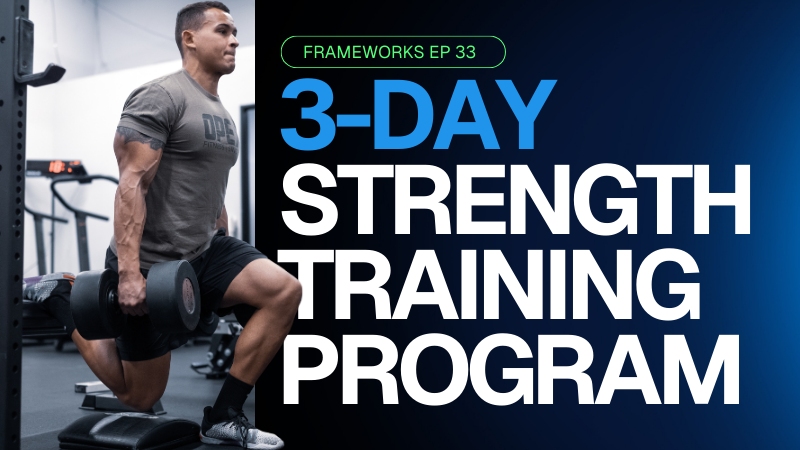
Designing a 3-Day Strength Training Program That Fits Real Life (Full-Body Split Framework)
If you coach (or train) long enough, you start to see the same problem over and over. People don't fail because they "need a better exercise." They fail because the plan doesn't fit their life, their schedule, their stress, or their body. That's why I keep coming back to a 3-day per week strength training program. I've used this split for myself for about 8 to 10 years.
Aerobic vs. Anaerobic Training for Coaches (Simplified With ATP)
Energy systems training gets messy fast. One coach says "aerobic base," another says "intervals," and suddenly we're arguing about zones, charts, and what counts as conditioning. I keep it simpler by anchoring everything to ATP, the energy currency of the body. If I can keep ATP available for the task, I can coach with more intention and less guesswork. From there, I sort training into three buckets I use all the time: Gain, Sustain, and Pain.
Beyond Motivation: A Goal Setting Framework That Sustains Progress
Most clients don’t quit because they don’t care. They quit because their goal was never connected to their real life. I’ve seen it over and over: someone comes in fired up, names a big outcome, and then life shows up. Work stress spikes, sleep tanks, motivation fades, and the “plan” turns out to be more hope than structure. That’s why I don’t treat goal setting like a hype speech. A good goal doesn’t create pressure, it creates direction. It tells us what to do on the boring Tuesday in week three.