

3X Bodyweight Deadlift & Running Program Design

What does good program design look like when the client is also a coach, has a clear strength target, and still wants to keep running? In this first episode of Behind the Design, OPEX coaches Daniel Persson and Brandon Gallagher walked through a real training plan, showed it inside CoachRx, and explained why each piece was there.
This series is set up as a weekly live breakdown, with coaches sharing decisions in real time (and taking questions live). Candace hosted from Arizona, Brandon joined from New York, and Daniel joined from Sweden, all focused on one thing: showing how a program gets built, adjusted, and improved week by week.
Meet the coaches (and why this series exists)
OPEX Coach Daniel Persson has 10-plus years of coaching experience, has owned and managed a CrossFit gym, and now coaches full-time remotely.
OPEX CoachBrandon Gallagher also has about a decade in coaching, previously owned gyms, spent years traveling while training professional MMA athletes, and now focuses on bigger projects back home.
The point of the series is simple: coaches don’t just “write workouts.” They listen, set priorities, pick the right tools, then adjust when the real world shows up.
The client scenario: a 3x bodyweight deadlift, without giving up running
Daniel reached out to Brandon for coaching for two reasons:
He wanted to be coached, not because he couldn’t write his own plan, but because it keeps him in the client seat and sharpens his own coaching.
He was done experimenting and wanted more structure and focus.
The primary performance goal was clear: a 3x bodyweight deadlift. That had been on Daniel’s mind for years, and he’d come close before.
At the same time, running mattered to him, not as an afterthought. He’d come to enjoy it, it helped his mental health, and it kept his “athletic” feeling while chasing heavier pulls. He had also been running every day as part of a 100-day streak when they first started talking.
So the job wasn’t to pick deadlifts or running. The job was to choose priorities, then make both fit.
How Brandon organized the coaching experience in CoachRx
Before the training week even starts, Brandon sets up structure inside CoachRx. One piece he highlighted was a “welcome” checklist that covers the onboarding essentials:
App walkthrough video (so clients know how to use the platform)
Intake form
Contract and waiver
Payment setup
Documents on training philosophy, SOPs, and how he coaches
Referral program
Equipment checklist
That early structure removes guesswork. It also gives the client clear steps so training starts clean.
If you want to try the platform they used in this walkthrough, there’s a CoachRx free trial.
The first training layout (and why it looked like this)
The initial week used a five-day or six-day rhythm built around lifting and running:
On paper, it covered a lot of bases. It also made sense given Daniel’s running streak and the deadlift goal.
Then the first month happened, and the plan needed to change.
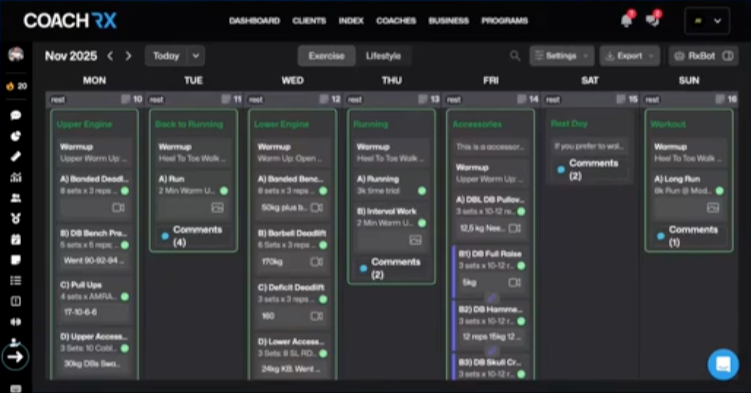
The warm-up philosophy: keep it consistent so you can spot problems early
A big part of this plan wasn’t flashy, it was repeatable.
Brandon kept the warm-up fairly consistent across sessions. The reason was practical: when you do the same key warm-up pieces often, you notice when something’s off.
Daniel called out the same benefit. If warm-ups change every day, there’s no baseline. If the warm-up is steady, you can tell when balance feels weird, hips feel tight, or coordination is off.
The warm-up included elements like:
Open book stretch
YTWs and shoulder swimmers
Scapular push-ups
Heel-to-toe walks, heel walks, toe walks
Knee hugs
Single-leg RDLs
Hip airplanes
Brandon also emphasized the hip airplane and single-leg RDL as valuable for hip health and performance.
Why low-level plyometrics showed up (even in a strength plan)
Another part of the warm-up was low-level plyos, such as banded pogos, single-leg pogos, switch-foot pogos, and extensive knee jumps.
The goal wasn’t to turn the training into a plyo program. It was to keep a thread of elasticity, foot strength, and tendon health year round.
Brandon tied this to his MMA background: athletes often go from “off-season” to “camp” fast. Keeping a small dose of springiness in the system helps transitions feel safer than going from zero to full speed.
Daniel’s takeaway was simple: it helped “guard” athleticism while pushing heavy deadlifts and still running.
Condensed conjugate: the strength framework they used
Brandon described using a “condensed conjugate” approach.
Traditional conjugate training (popularized by Louie Simmons and Westside Barbell) often uses four days, with max effort and dynamic effort work for upper and lower.
Condensed conjugate takes the dynamic effort piece and layers it into fewer sessions. In this plan, that looked like:
Upper day with a dynamic effort lower movement on top (to keep fatigue managed)
Lower day with a dynamic effort upper movement on top
This let Daniel hit speed and power without turning the week into a grind.
Accommodating resistance: why bands were used on deadlifts and bench
They used banded deadlifts and banded bench press for speed work. Bands change the resistance through the lift, so load increases as you move into stronger positions.
Brandon explained it with a simple example: if it feels like 100 kg at the bottom, it might feel closer to 120 kg at the top because band tension increases.
The coaching cue stayed the same across both lifts: don’t sacrifice speed for weight. Pop matters more than load on these sets.
They used eight sets of three reps on the banded bench press, around 50 to 60 percent, focusing on short rest, rhythm, and explosive intent off the chest.
Why video feedback matters more than “checking the box”
A big coaching point in this episode was the difference between completion and quality.
Daniel talked about how important it is for clients to upload videos and leave comments, because it gives the coach data beyond numbers. Brandon agreed and added that without visual feedback, online coaching misses too much.
A rep can be “done” and still be ugly, slow, or risky. Video lets the coach see details like bar speed, positioning, and effort. In their example, Brandon was able to cue Daniel to press faster off the chest. Without the video, that coaching moment doesn’t happen.
Their broader point was about the feedback loop:
Coach prescribes, client executes, client reports (notes and videos), coach adjusts.
That loop is where the program becomes personal.
Accessories and “bodybuilding day”: hard work without draining the week
Brandon also spoke about organizing training around key movement patterns (squat, hinge, push, pull, vertical, horizontal, plus single-leg, carries, and core). It’s a simple way to sanity-check a week.
One feature of the plan was a bodybuilding-style day. It wasn’t there to chase soreness. It was there to get useful work done without the fatigue cost of heavy compound lifting.
Moves like pullovers, lateral raises, hammer curls, skull crushers, and core work are hard in a local way, but they don’t usually wreck the nervous system. Brandon framed it almost like an “active recovery” day that still builds muscle and supports the bigger lifts.
Progression across weeks: small jumps, same structure
Over the first month, the structure stayed mostly the same. The progressions were small:
Slight jumps in percentage week to week
Same movements long enough to build skill and confidence
Minimal “random change” just for variety
The idea was consistency first, then progression.
The mid-course correction: when running started taking too much
After a few weeks, Daniel’s training notes started showing warning signs:
Higher heart rate on runs, paired with anxiety
Heavy legs early in sessions
Tightness and cramping tendencies
“Job done” vibes instead of feeling strong and ready
Those notes drove a conversation and then changes.
They made three big adjustments:
Removed the Sunday run, giving Daniel a full day off and more weekend recovery (and time for life).
Moved the deadlift to the first training day of the week, so the highest priority lift happened when Daniel was freshest after the weekend.
Changed the run approach, shifting away from outcome-based targets and toward time-based work at a comfortable pace, so running stayed in the plan without stealing from the deadlift goal.
Daniel highlighted an important coaching lesson here: coach the person, not the program. The fix wasn’t to hype him up. The fix was to adjust the plan to match reality.
Using lifestyle data: trends beat single numbers
Kandace asked whether they looked at lifestyle trends while deciding on changes. Brandon pointed to tracking inside CoachRx, including sleep, steps, recovery, and resting heart rate.
Daniel’s resting heart rate ran very low (mid-30s some nights). The key was not the absolute number, but the trend.
Both coaches emphasized the same idea:
Watch for drift in sleep, recovery, resting heart rate, and general feel.
Use numbers to support decisions, not to replace coaching judgment.
Kandace also mentioned newer CoachRx features like Insights, status rings, hover profiles, and the coaching dashboard, all designed to make those trends easier to spot.
Templates vs individual design: what goes in a program library?
A live question came in about using templates and the programs library.
Brandon’s approach was to save programs when they’re truly useful as a reference later, often after a full three-month run. He might keep frameworks (like condensed conjugate) and reuse parts, but he doesn’t copy and paste a full program to a new person.
Daniel shared a similar view: it’s easier to store components (progressions, cycles, running builds) than full templates, because individual needs change so much.
If you’re building coaching skills and want more structured education around principles and decision-making, they also shared the OPEX Method Mentorship.
Connect with the coaches
Brandon Gallagher: Brandon’s Instagram (@bgperform_)
Daniel Persson: Daniel’s Instagram (@danielcapersson)
Conclusion
Good program design isn’t about writing the “perfect” week on the first try. It’s about setting a clear priority (in this case, a 3x bodyweight deadlift), building a structure that supports it, and then listening closely when the body pushes back.
The biggest theme from this episode was feedback. Notes, videos, and lifestyle trends turn training into a two-way conversation, and that’s what makes the plan better over time.
If you want them to cover a specific client avatar or training goal in a future breakdown, drop a request in the comments on the video and follow along as the series continues.
Join us live on Tuesdays mornings 10:30am EST on the OPEX YouTube Channel
Start your free 14-day CoachRx trial and bring principled programming, habit tracking, and high-touch communication all in one seamless coaching command center.
