

How Daniel Persson Programs a Former Competitive CrossFit Athlete

A lot of training problems don’t show up on paper. Someone can have years of experience, solid nutrition, and a decent sleep routine, yet still feel stuck. Motivation drops, aches creep in, and the old approach no longer fits.
This Behind the Design session from OPEX Fitness is a great example of how program design changes when an athlete shifts from competing to training for health, longevity, and “still being able to play” once in a while. Daniel Persson and Brandon Gallagher walk through the intake, the reasoning behind the first week of training, and the early adjustments that came after real feedback.
Who this client is (and why the context matters)
Daniel’s example client is:
47 years old
Highly experienced, with a background in mixed martial arts, then later CrossFit and Olympic weightlifting
Previously competitive in CrossFit, but no longer training to compete full time
An OPEX CCP coach, so he understands programming concepts and can give thoughtful feedback
That last point changes the coaching relationship. This is not someone who just wants a workout of the day. He wants a plan with a clear purpose, plus the ability to talk through the “why” behind it.
The big training constraint: the knee
The major limiting factor was his right knee, which affected:
Deep squat patterns
Jumping
He also had some past shoulder and biceps issues, but those weren’t major current problems.
The key design goal early on was to avoid making the program feel like a list of limitations. If the first week feels like, “Here’s everything you can’t do,” motivation drops fast.
What he wanted now: motivation, structure, and room to “play”
This client wasn’t asking for a peak cycle. He was asking for something harder in its own way: consistency without the competitive hook.
His top priorities were:
Find motivation again after stepping away from competition
Train for health, strength, and conditioning long term
Stay injury-free
Have a structure that fits his real life
Still be able to “play” with fitness sometimes, including being ready for the CrossFit Open (not as a win-at-all-costs goal, more as a readiness marker)
That mix creates a tight coaching challenge. You need structure and progression, but you also need enough sport flavor to keep the athlete engaged.
The intake questions that shaped the program
Daniel highlighted a few intake areas that directly affected design decisions.
1) “What training is fun, and what kills your motivation?”
Daniel likes asking experienced clients what they consider “fun training” versus what drains them. It’s a simple filter that helps you avoid building a technically perfect plan the client hates.
For this client, the “fun” criteria were clear:
Sessions can’t be too long
They can’t be too complex
They need a clear purpose
They should feel connected to training beliefs he already has (buy-in matters)
Brandon mentioned he doesn’t always ask it that directly, but he does explore training history, and what they liked or disliked about past coaching. Either way, the goal is the same: find the friction points before they show up as missed sessions.
2) Expectations of the coach (and how much explanation they want)
Daniel also asks what the client expects from him as a coach. This matters more than people think.
Some clients want:
Honest feedback
Back-and-forth discussion
New ideas and refinement together
Other clients want:
Today’s workout
Minimal explanation
No mental effort spent on training
This client, being a coach, wanted the conversation and the thinking. That changes how you communicate the plan, how you frame progress, and how much education is included week to week.
3) Outcome goals vs habit goals (especially for former competitors)
Daniel made an important point about athletes who come from competition: they’re trained to set outcome goals.
Win this event
Hit this number
Perform on this date
When they move into a health and longevity phase, they often need help shifting toward habit goals.
Strength train four days per week
Keep intensity in check
Build repeatable conditioning without getting wrecked
That shift is part programming, part identity work. The program has to support it.
A key decision: start with four days, not five
The client said he’d like to train five days a week, but admitted four was more realistic.
Daniel went with four training days per week as the starting point, with sessions targeted at 60 to 90 minutes. This was partly a lifestyle fit, and partly protection against his tendency to do too much.
Brandon backed this up from a momentum standpoint: the first week should feel digestible. Ideally, the client finishes thinking, “I could’ve done more,” because that keeps them coming back and builds consistency.
The structure Daniel used: “condensed conjugate” meets CrossFit needs
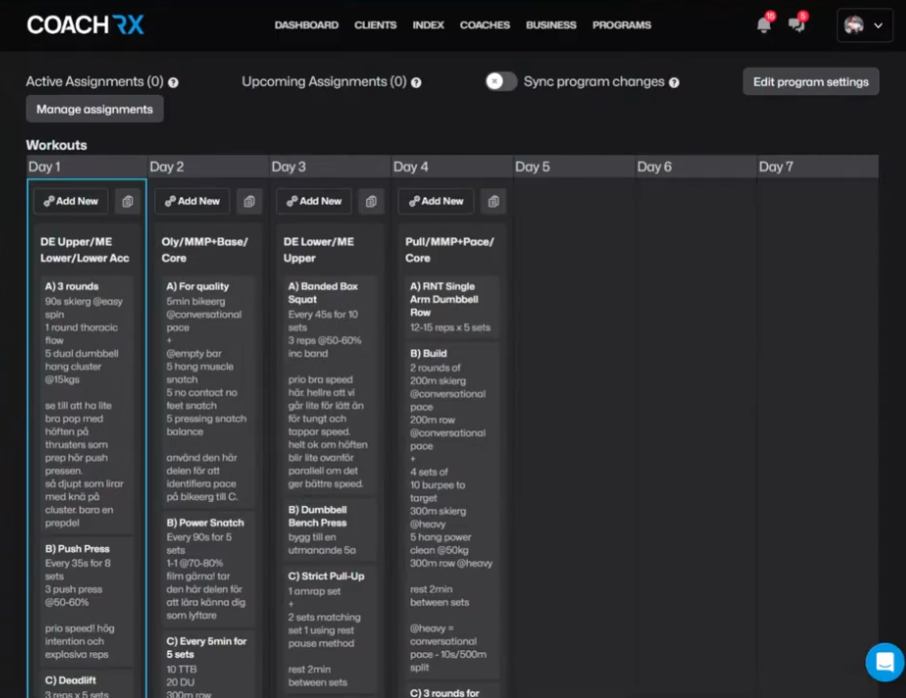
Daniel referenced the “condensed conjugate” structure they discussed in the previous episode, then showed how he adapted it for this client.
The point wasn’t to force a template. It was to use a familiar structure that:
Creates clear intent each day
Keeps sessions efficient
Leaves room for CrossFit-style conditioning and skills
Avoids too much downtime
He also leaned toward full-body sessions, which tends to work well for CrossFit-style athletes because it spreads volume and helps them recover between sessions.
Week 1 overview: what each day was trying to accomplish
Daniel walked through the first week in detail, including how he thinks about warm-ups, strength pieces, and conditioning.
Day 1: prep work, push press, deadlift, then a CrossFit-style accessory finisher
He starts with a “middle zone” piece, not just a basic warm-up, but not full intensity either. The purpose is to get the body moving, prep patterns, and reduce ramp-up time later.
This included:
SkiErg work
Thoracic flow
A double-hand cluster (used to prep hip pop and the push press)
Then came the main pieces:
Push press (dynamic effort focus)
Deadlift (strength focus)
He then used a CrossFit-flavored accessory circuit to build capacity while staying time-efficient:
Hard bike effort (short interval)
Sandbag hold
Kettlebell swing
Rest, then repeat for sets
This is where you can see the “sport feel” show up without turning it into random chaos.
Day 2: build a pacing reference, power snatch, then controlled mixed modal conditioning
Daniel used the early part of the session to establish a conversational pace on the bike for five minutes. That pace later becomes a reference point inside the conditioning workout.
Then:
Power snatch work
Then a conditioning format Daniel likes for masters athletes:
Every five minutes for five sets:
Toes-to-bar
Double-unders
300-meter row
Bike at the pre-set pace
Daniel’s reasoning here was sharp: he wanted to control time and total “tough contractions.” A 25-minute AMRAP can explode in volume, especially with a motivated and experienced client. This structure keeps the client working, but limits the risk of accidentally doing too much too soon.
Day 3: speed squat, dumbbell bench, then “quality” CrossFit accessories and a skill touch
This day included:
Band and box squat (speed work)
Build to a tough set of 5 on dumbbell bench press
Pull-ups
Then a CrossFit-style accessory piece, but with a clear note: complete with quality. Daniel called out something many coaches run into: CrossFit athletes are trained to chase speed and intensity. If you want a different stimulus, you need to say it clearly.
This finisher included:
GHD sit-ups (core)
Biceps work
More pulling
Handstand hold attempts (skill play)
Daniel also mentioned a smart motivational choice here. The client said he struggles with pulling patterns in gymnastics. Daniel could’ve made an entire “fix your weakness” day, but early on, that can crush enjoyment. Instead, he spread pulling exposure across the week.
Day 4: conditioning-focused session
The last day was more conditioning heavy, built around repeating efforts and keeping work challenging but repeatable. The intent was to start building capacity without turning it into a suffer-fest that wrecks recovery.
How Daniel thinks about progressions (without losing the CrossFit athlete)
A big part of this episode was the tension between:
CrossFit athletes often wanting constant variation
Good coaching requiring enough consistency to track progress
Daniel’s approach was simple:
Start with more structure so you can assess tolerance and response
Ask the client to tell you if they truly need more variation
Use small changes that keep pieces trackable
He shared early progression examples:
Push press moving toward a consistent target (he referenced 50 to 60 percent and settling at 60 percent)
Deadlift moving toward a triple as part of a longer progression
Slight changes in conditioning pieces (example: adding push-ups into the toes-to-bar and double-under structure to nudge demand without blowing up the session)
Brandon added an important clarification: variation is fine when the stimulus stays the same. If the goal is a single-leg accessory that supports the deadlift, you can swap lunges for step-ups and still stay on track. The “why” stays stable, even if the movement changes.
A coaching mistake that showed up fast: he trained all four days in a row
This part matters because it’s real coaching, not theory.
Daniel initially laid out the week in a way that allowed the client to do all four sessions in a row. The client got excited and did exactly that.
Result: minor aches and signals that he needed to pull back.
Daniel’s reflection:
He would now build in rest days more intentionally for this client
Especially given the history of doing too much and pushing intensity
The fix: reduce spinal loading and pull back slightly
To help the client recover while staying consistent, Daniel made a few adjustments:
Swapped in barbell hip thrust for that week to take some load off the spine
Removed a hold that added extra spinal tension
Kept the week moving forward while lowering the cost
That’s a strong early coaching move. The goal isn’t to “win the week.” The goal is to keep the client feeling good enough to train next week.
Lifestyle tracking: watch the trends, not one bad night
Near the end, the host asked about lifestyle factors like stress and inconsistent sleep.
Daniel’s approach was to avoid overreacting to single data points. He wanted a couple of weeks to see trends before making bigger lifestyle pushes.
The client was already syncing a watch and tracking food, so they had data coming in. Daniel’s plan was to:
Start training first
Keep an eye on lifestyle markers
Revisit and dial it in after a few weeks (around the first follow-up consult)
Autonomy tools: helpful, but not always right away
They also touched on CoachRx features that allow clients to move sessions around and swap exercises.
Daniel’s take was balanced:
He did allow moving sessions around
He was cautious about giving too much autonomy early, even for an experienced client, because this client could overdo it
He tends to open up more autonomy over time, once the relationship is strong and decision-making is solid
That’s a useful reminder: experience doesn’t always mean restraint.
Conclusion: Good design is clear, trackable, and still fun
This episode showed what happens when a coach builds training for a former competitor who still wants to feel athletic. The program needs structure, but it also needs room for sport-style movement, and it has to respect recovery.
The standout themes were simple: start with less than they think they want, control early variables, and adjust quickly when real life shows up. Motivation often comes back when the training feels doable again, and the purpose is obvious. If you’re coaching someone through a similar shift, build the plan so they can win the week, then stack weeks until consistency becomes the new competitive outlet.
For more from the coaches featured here, you can follow Brandon Gallagher on Instagram and Daniel Persson on Instagram.
If you want to see the platform they referenced in action, OPEX also shared a CoachRx free trial and details on the OPEX Method Mentorship.
If you’re building coaching skills and want more structured education around principles and decision-making, they also shared the OPEX Method Mentorship.
Connect with the coaches
Brandon Gallagher: Brandon’s Instagram (@bgperform_)
Daniel Persson: Daniel’s Instagram (@danielcapersson)
Join us live on Tuesdays mornings 10:30am EST on the OPEX YouTube Channel
Start your free 14-day CoachRx trial and bring principled programming, habit tracking, and high-touch communication all in one seamless coaching command center.
