

Coaching Other Coaches: Why Great Coaches Still Need a Coach

If you coach athletes for a living, you're still the hardest person in the room to coach. Your own training mixes ambition, bias, curiosity, and fatigue in a way that is hard to judge honestly. That is why this conversation lands so well. Daniel Persson and Spencer Kankel show how good program design comes from clear priorities, honest feedback, and the willingness to let another coach hold the plan steady.
If you coach athletes for a living, you're still the hardest person in the room to coach. Your own training mixes ambition, bias, curiosity, and fatigue in a way that is hard to judge honestly.
That is why this conversation from OPEX Fitness lands so well. Daniel Persson and Spencer Kankel show how good program design comes from clear priorities, honest feedback, and the willingness to let another coach hold the plan steady.
Great coaching is often quiet on the competition floor
Before the program breakdown even started, Daniel shared a fresh lesson from coaching at the French Throwdown. His athlete had already been to the Age Group Games the year before, but this trip was not about chasing another qualifier. The goal was simpler, enjoy the event, compete well, and be fully present for the weekend.
That changed the coach's role.
Daniel talked about how easy it is for coaches to focus on tactics, strategy notes, and all the technical details they want to fix afterward. Those things matter. Still, one of the strongest coaching skills is empathy. Being with an athlete through the highs and lows of a competition gives a coach better feel, better timing, and better judgment.
On competition day, the coach's job is to be present and useful, not the main character.
That line runs through the whole episode. A coach does not need to dominate the floor with a new speech before every workout. Most of the work should already be done. The athlete should already know how to approach workouts, how to think through pacing, and how to manage their own fitness IQ. At the event, the coach is there to steady the moment, hear the athlete's concerns, and help them process what is happening without taking over.
Daniel also made another strong point. Competition answers back. If something shows up on the floor, the coach should not rush to defend authority or explain it away. That result is information. It is no different from spotting a movement fault in training. You look at it, learn from it, and use it to improve the next block.
Why Spencer Crankle asked another coach to program his training
One of the best parts of the OPEX community is how often coaches work with other coaches. Daniel works with Brandon Gallagher on his training. Spencer works with Daniel. That kind of setup says a lot about the culture. Serious coaches do not assume they should handle everything alone.
Spencer put it plainly. He can write his own training, but he will not follow it the same way. He needed a third party to "guard" the program. That is a strong phrase, and it fits. When you coach yourself, it is easy to rewrite the day based on mood, switch directions because a new idea sounds fun, or lose the thread of a long-term plan.
A coach helps because:
It removes the daily emotional bias that creeps into self-programming.
It protects the long-term direction when you want to change course every week.
It creates a learning loop, because you get to study another coach's choices from the inside.
Daniel made a similar point from the coach's side. Many coaches swing between two extremes. Sometimes they want structure and outside direction. At other times, they want to use their own training as a test site for every idea they have. There is nothing wrong with experimenting. The problem starts when every week becomes a new experiment and the larger goal disappears.
That was part of Spencer's reason for reaching out. After years of competitive CrossFit, big life changes, and the fatigue of checking boxes every day in a training app, he wanted a plan that still moved him forward without demanding full-throttle competition mode every session.
The goals were simple numbers, but they mattered
Spencer's athletic background helps explain why these goals made sense.
Long before CrossFit, he was a rower in high school and trained at a high level. At one point, he was working toward the US national team track in rowing. That meant two-a-day sessions, heavy endurance volume, and a lot of comfort with long hard work. He liked the grind, and he liked sports where the body tells the truth.
When he found CrossFit in early 2017, it clicked for a similar reason. He first saw it through one of the "Fittest on Earth" documentaries and thought it looked fun. Then he went to a class and got crushed by regular gym members. That was enough to hook him. There was a lot to improve, and he wanted the challenge.
From there, he bounced through several competitive programs, including larger templates that were common at the time. He also spent a year with Matt from The Gains Lab in a semi-individual setup, then worked for several years with coach Paul Weber. There was even a period where he stepped away from CrossFit to focus on endurance work again.
By the time he and Daniel started working together, the goals were not tied to a competition calendar. They were clean strength markers: a 315-pound power clean, a 405-pound squat, and a 315-pound bench press. Spencer said those numbers were not magical. They were benchmark numbers, the kind that keep training pointed. More than that, they felt like unfinished business. During his competitive years, he believed there was still some strength left untapped, and those numbers gave that feeling a target.
How the weekly split put strength first
Daniel's weekly layout started with one simple question: what matters most right now?
In Spencer's case, the answer was strength. So the week was built around that first, then the rest of the training got arranged around it, including a Thursday running club that Spencer wanted to keep.
Here is the basic structure Daniel built:
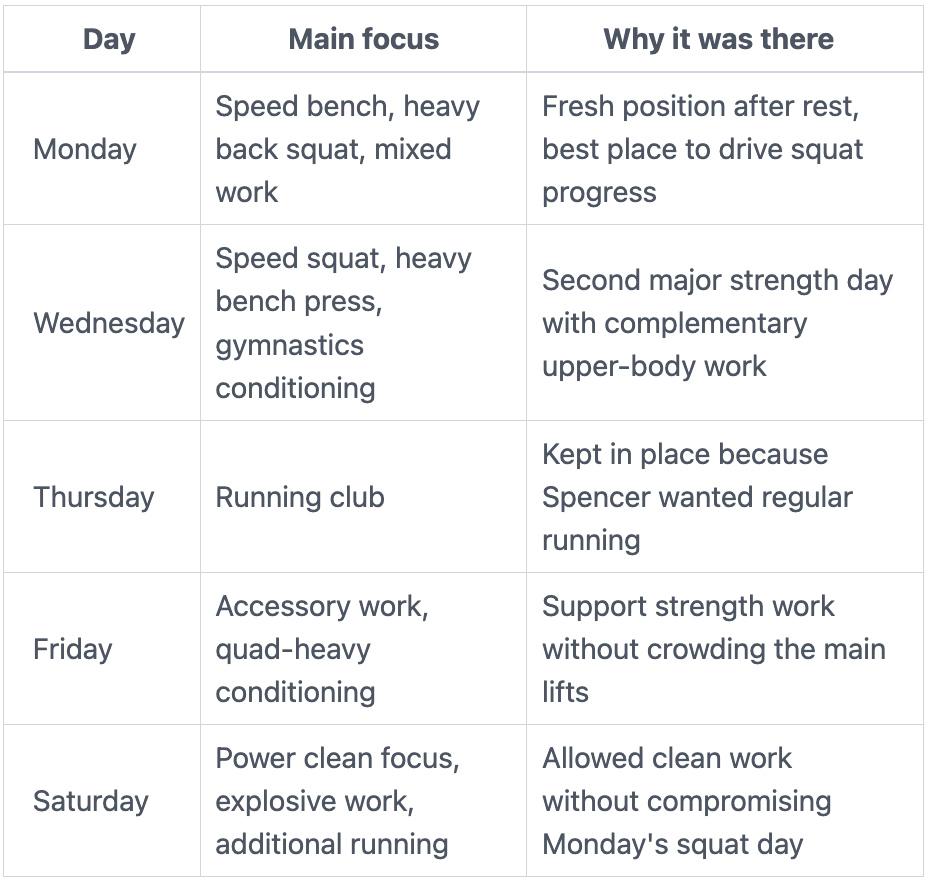
The split looks simple on paper. That is part of the point. Daniel said he would rather start a little lighter and add later than flood a new client with volume too early. Precision came first.
Monday and Wednesday carried the main load
If you know conjugate ideas, you can see them in this setup. Monday and Wednesday both paired a speed-focused lift with a heavier strength movement. On Monday, that meant banded bench press first, then heavy back squat. On Wednesday, it flipped with a banded box squat and then bench press.
The order mattered. Daniel wanted the fastest movement first because of the strength-speed continuum. A speed exercise asks more from the nervous system. So even though the back squat was the main lift on Monday, the banded bench press came before it because its purpose was bar speed.
That level of ordering is what separates a plan from a pile of exercises. The movement is not only about what gets trained. It is also about when the athlete sees it, what quality is freshest, and what kind of output the coach wants from the set.
Accessory work still looked like CrossFit
Daniel did not bury Spencer in isolated bodybuilding work. Instead, he folded much of the accessory training into mixed-model pieces that still felt close to the sport.
One example was a cyclist-style dumbbell squat variation paired after the squat work. Daniel noticed that Spencer's knees tended to shift back, which can leave the quads underused and make it harder to stay upright in the squat. So the support movement aimed straight at the quads.
Other pieces used sandbag reverse lunges, power snatch singles, short runs, ski work, and hard cyclical efforts. The goal was not to smash a random metcon. Daniel used those pieces to control volume, add useful contractions, and keep Spencer connected to CrossFit patterns without turning every accessory block into a full competition effort.
That balance matters. If you are a mixed-modal athlete, support work does not have to look like a separate sport. It can still speak the same language as the sport, as long as the coach keeps the volume and intent under control.
Skill work under fatigue can be smarter than more fresh reps
One of the sharper ideas in the program was how Daniel handled gymnastics.
On one day, the complementary work after bench press included strict handstand push-ups and strict chest-to-bar pull-ups with one to two reps in reserve. That was not only training. It was also assessment. Reps in reserve only work if the athlete has enough awareness to judge effort honestly. Spencer did, so Daniel used that to learn from the session while still driving progress.
Then came a more sport-like piece. Spencer skied at changing paces and moved straight into a complex of ring muscle-ups, strict ring dips, and burpees. On paper, the ring muscle-up volume was low. In practice, the context made those reps much harder.
That is the idea Spencer liked most. High-skill movements do not always need high-volume fresh practice. When you put them after cyclical work or under local fatigue, you can get a better touch on how they feel in competition while keeping the total rep count lower.
For movements like ring muscle-ups or handstand push-ups, that matters. They are technical, demanding, and a little less forgiving than simpler patterns. Piling up rep after rep can beat up the shoulders, elbows, neck, or head. A tougher context with fewer total reps can give the athlete what they need with less wear and tear.
Daniel framed this well. Progress is not always about adding more reps. Sometimes you change the context. You ask the athlete to perform the same skill after a ski effort, or with tired triceps, or after a pacing shift. The task stays familiar, but the challenge grows.
Why less training volume produced better sessions
Early in the working relationship, one thing stood out to Spencer right away. The total training volume was much lower than what he had been doing before.
That is common when athletes move from broad competitor programming into a more precise one-on-one design. Daniel said he prefers to start with less, then add if needed. It is easier to build up than to strip down a week that already has too much inside it.
Spencer was honest about the appeal of high volume. In CrossFit, athletes often like to say they respond well to lots of training. Sometimes that is true. There are seasons of life where someone has the time, recovery, and motivation to train a lot and enjoy it. Spencer has had those seasons himself.
Still, more work is not the same thing as better adaptation.
When the volume came down, he said his body felt better. Recovery improved. The quality of the key sessions went up. That was the bigger win. He made the point in a way many endurance athletes will understand. A hard rowing test gives you hundreds of strokes where you decide whether to keep suffering. A 3RM squat gives you three reps. Strength work often feels less dramatic, even when it is exactly what the athlete needs most.
That creates a problem for some CrossFitters. They start to confuse suffering with usefulness. If the session does not leave them gasping, they feel like they did not work hard enough. Then they add more volume, more mixed work, more zone 2, or another session later in the day, not because the program needs it, but because their identity expects it.
Before adding a second session, Daniel's standard is much simpler:
Does this work need its own slot for quality or schedule reasons?
Does it support the athlete's top goal?
Will it improve the main session, or drain it?
That last question matters most. Spencer said he could probably tolerate much more work. But if they layered extra conditioning on top of the block, the heavy lifts would likely suffer. A few more minutes of box-checking could cost real pounds on the bar.
Daniel shared a strong real-world example from another athlete. She came to him nearly worn out, with daily training sessions around two and a half hours and a growing urge to quit competing. He cut her volume in half. The result was not a decline. She returned to the Age Group Games and also won a world title in functional fitness. Less volume gave her back performance and enjoyment.
There was also a useful warning about online fitness culture. Spencer said it is misleading when former Games athletes post that they now look or perform a certain way on only 45 minutes a day, while leaving out years of massive training history. Maintenance volume is much lower than development volume. Once you have built a large base of strength and skill, it takes less to keep it than it took to create it.
That distinction matters for coaches. Athlete history changes what "enough" looks like.
The power clean fix started with one small constraint
The clean work in Spencer's plan is a great example of how good coaching often comes down to one smart adjustment.
Daniel reviewed Spencer's power clean and saw room for better hip extension at the top. He believed that if Spencer extended more fully, there was more weight available on the bar. So instead of hammering more normal power cleans, he added a complex: one power clean and one high-hang power clean.
The logic was simple. If an athlete avoids a position, spend more time there.
In Spencer's case, the high-hang start removed one of the cues he usually relied on. He was used to feeling the bar travel up the thigh and into the hip after the bar passed the knee. Starting from the high hang took away that buildup. At first, it felt awkward. He even described it as feeling like his brain was breaking while he tried to sort out the movement.
That is often a sign that the drill is doing its job.
Daniel also noticed that Spencer initially tried to rock back and forth to get the bar moving. The high-hang position cut off that escape route. With the bar already high, the clean had to start with better extension. By the second week, the difference was obvious. The hip finish was cleaner, and the bar moved better.
Spencer felt the change right away. When he hit the movement well, the bar felt lighter and the catch felt snappier. That kind of immediate feedback is gold in training. Video is helpful, but an athlete who can feel the difference between an efficient rep and a wasteful rep learns much faster.
There is a bigger lesson there, too. Athletes often avoid positions where they feel weak or unstable. Good design does the opposite. It puts them there on purpose.
Where to keep learning from these coaches
If this style of coaching speaks to you, there are a few good places to go next.
For the larger framework behind this kind of individual program design, the OPEX Method Mentorship is the direct path. If you want to see how coaches manage training, communication, and athlete autonomy inside a platform, you can also start a CoachRx free trial.
You can follow the coaches who appeared in this conversation through their own channels. Daniel shares coaching and training updates on Daniel Persson's Instagram. Brandon Gallagher, one of the regular hosts of the series, posts at Brandon Gallagher's Instagram.
Spencer shares his work at Spencer Crankle's Instagram. Spencer also mentioned his show, Performance Programming Simplified on YouTube. The channel focuses on competitive CrossFit program design, common pain points for athletes, and how to place yourself more honestly on the spectrum between beginner and elite. Daniel also shared that more content is on the way from his recent trip to Paris.
Final thoughts
The hardest athlete to coach is often yourself. That is why this conversation works so well. It shows that good program design is less about stuffing a week with more work and more about choosing the right work, putting it in the right place, and staying honest about what the athlete needs.
Daniel and Spencer also show something bigger. Coaching other coaches only works when both people stay open, precise, and willing to learn. When that happens, the program gets cleaner, the sessions get better, and progress stops feeling crowded.
Connect with the coaches
Brandon Gallagher:Brandon’s Instagram (@bgperform_)
Daniel Persson:Daniel’s Instagram (@danielcapersson)
Join us live on Tuesdays mornings 11:30am EST on the OPEX YouTube Channel
Start your free 14-day CoachRx trial and bring principled programming, habit tracking, and high-touch communication all in one seamless coaching command center.
