

How Reps and Sets Shape Program Design

Most coaches spend plenty of time picking exercises, then rush through reps and sets like they're the easy part. They're not. Once tempo is set, reps and sets are the final tools that tell the body what to adapt to.
In OPEX Fitness's Behind the Design series, Brandon Gallagher and Daniel Persson make a simple point that changes how you program: a good session doesn't happen by accident. It happens when load, tempo, reps, and intent all point at the same outcome.
Reps and sets only work when the goal is clear
Tempo gives a movement its pace and character. Reps and sets finish the job. If you know how long each rep takes, you can estimate how long a set lasts, and that helps you predict the training effect.
That's why these choices shouldn't feel random. A set of 5 with a slow tempo creates a different session than a set of 12 with the same exercise, even before load enters the picture. OPEX has written about this same idea in its recap on program design inside the OPEX Method.
A quick way to frame it is this:
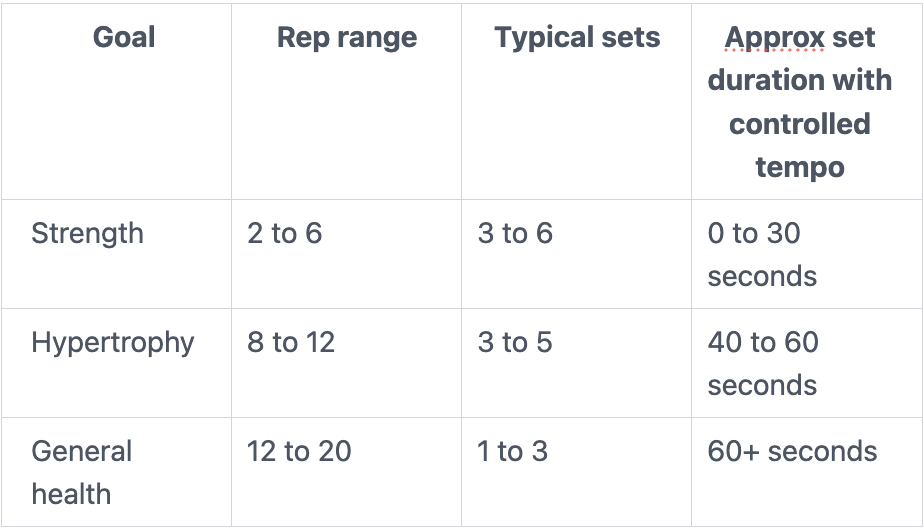
The table isn't a law. It's a starting point. Exercise choice, training age, weekly volume, and session order all matter too, but the main takeaway is clear: the rep scheme has to match the stimulus.
Match the rep range to the adaptation you want
Strength is both a physical adaptation and a skill. If someone wants to get strong, they need practice moving heavy weight, and that means lower reps. For big lifts, Gallagher and Persson land around 2 to 6 reps, often across 3 to 5 sets, with singles, doubles, or triples showing up when the goal shifts toward peak expression.
Singles also fit well inside time-based formats, like every 45 seconds or every minute, because they let you practice heavy reps without turning the whole session into a max-out. For experienced lifters, a back-off set after heavier work can also make sense. A few hard sets build strength skill, then a lighter high-rep set adds more muscle-building work.
Hypertrophy is different. Here, the sweet spot is usually 8 to 12 reps. That range gives plenty of time under tension without the misery and sloppy loading that often show up with 20-rep sets on bigger lifts. It's also easier for most clients to judge effort there. A set of 20 bench presses can feel brutal long before it reflects the right stimulus.
Movement choice matters too. A 1-rep max close-grip bench press can make sense. A 1-rep max bicep curl almost never does. The simplest filter is often the best one: does this rep range make sense for this movement?
For general health, the conversation shifts again. Higher rep work, often 12 to 20 reps for 1 to 3 sets, gives more time to practice motor control and hold on to muscle mass. Persson ties that to aging well. As people get older, they need to keep muscle and movement quality, not only chase top-end strength. Training helps "resist entropy," or in plain English, resist the body falling apart.
Autoregulated ranges turn math into coaching
A rep range is not a sign that the coach couldn't decide. It's a built-in tool for load selection.
If the program says 8 to 10 reps, the client should use a weight that keeps every set in that window. Hit 10 reps across the board, then the load should go up next time. Miss 8, and the load is too heavy.
If a client reaches the top of the rep range on every set, it's time to add weight.
That sounds obvious, yet coaches see this missed all the time, especially online. Clients often treat "did all 10 reps" like a gold star, even when that result means the weight stayed too light. Good coaching notes fix that. Training history helps too, which is why tools like the CoachRx free trial matter in practice. Past performance gives clients a better starting point on the next week.
This gets harder when you're not in the room. In person, you can see the last rep, the breathing, the speed change, the face someone makes when they're close to a limit. Online, you need clear explanations and video feedback.
Persson shared a strong example with a client who wanted a ring muscle-up. She kept asking for more drills, but the real problem was pulling strength. Once she started treating basic accessory work with more intent, progress changed.
Treat a bicep curl with the same focus you'd bring to a heavy deadlift.
That line gets to the heart of it. Fancy drills don't replace hard, honest work.
Applying these rep ranges to a real program
Upper-body session choices
For a close-grip bench press with a 30X1 tempo, the recommendation stays in the strength zone: 3 to 5 sets of 4 to 6 reps. It fits the exercise, the tempo, and the goal of moving meaningful load.
A forearm-supported three-point row works better as a back-building accessory, usually 2 to 4 sets of 6 to 10 reps. That keeps quality high without turning the row into a grind. It also reflects a bigger coaching truth: a strong, muscular back usually comes with real strength elsewhere.
The seated dumbbell press shifts higher because the exercise sits later in the session and the 2121 tempo limits loading. A solid target is 2 to 4 sets of 8 to 12 reps. The same logic carries over to a high-to-low cable fly and a cable lat pulldown, which also fit well in the 8 to 12 range.
For dumbbell side bends, the goal is less about max load and more about clean movement through spinal flexion and return. 2 to 3 sets of 12 to 20 reps work well there.
Lower-body session choices
The leg press can sit closer to strength work because the machine adds external stability. A useful range is 4 to 8 reps, and Persson notes that an opening set of 8 to 10 can prepare the pattern before heavier sets.
Romanian deadlifts can go both ways. In this program, 2 to 4 sets of 6 to 8 reps make sense, but higher reps can work too if the goal is more hypertrophy. When grip becomes the limiter instead of the hinge, straps can help keep the work on the target muscles.
Reverse lunges need more patience. After leg press and RDLs, they fit better as integrated accessory work, usually 2 to 3 sets of 6 to 10 reps per side. Depth and control should beat heavier loading early on.
Seated hamstring curls land near the end for a reason. After compound work, they isolate the hamstrings well with 8 to 15 reps. That tempo-controlled setup is a good place to chase full range and quality contraction instead of heavy singles.
GHD hip extensions round out the posterior chain nicely in the 8 to 12 rep range, while hammer curls fit the same higher-rep accessory logic as hamstring curls.
Coaching gets better when the coach stays a student
One of the better points from this discussion had nothing to do with bench press numbers. Persson talked about going back through the OPEX Method Mentorship even after years of coaching, running a gym, and building a remote business.
That mindset matters. The best coaches keep testing what they know, refining how they explain it, and learning from other coaches who care about mastery. OPEX also shares more on this style of thinking in its piece on program design tips for personal trainers.
The next step in this design series is a natural one: how to write notes that tell the client what to feel, how hard to push, and why the movement is in the plan.
Final thoughts
Reps and sets are not filler at the end of a program. They are part of the message. They tell the body whether to practice strength, build muscle, or spend more time on control and durability.
When stimulus is clear, the rest gets cleaner. Tempo, rep range, load, and coaching notes all start working together, and the program stops looking like a list of exercises and starts reading like a plan.
For the full pathway into this kind of program design, look at the OPEX Method Mentorship.
Connect with the coaches
Brandon Gallagher:Brandon’s Instagram (@bgperform_)
Daniel Persson:Daniel’s Instagram (@danielcapersson)
Join us live on Tuesdays mornings 11:30am EST on the OPEX YouTube Channel
Start your free 14-day CoachRx trial and bring principled programming, habit tracking, and high-touch communication all in one seamless coaching command center.
