

How to Use Tempo in Strength Program Design

A lot of programs tell you what exercise to do, how many reps to hit, and when to rest. Far fewer tell you how the rep should feel. That is where tempo matters.
In a Behind the Design session from OPEX Fitness, Brandon Gallagher and Daniel Persson showed how tempo turns a basic strength plan into real individual design. Their examples make one point clear fast: tempo is not filler, and it is not there to make training miserable.
A lot of programs tell you what exercise to do, how many reps to hit, and when to rest. Far fewer tell you how the rep should feel. That is where tempo matters.
In a Behind the Design session from OPEX Fitness, Brandon Gallagher and Daniel Persson showed how tempo turns a basic strength plan into real individual design. Their examples make one point clear fast: tempo is not filler, and it is not there to make training miserable.
Tempo is where individual design starts
Tempo is the speed of each part of a rep, and it is usually written left to right: eccentric, pause, concentric, pause. A prescription like 30X1 means 3 seconds down, no pause at the bottom, an explosive drive up, and 1 second at the top. For a quick refresher on the notation, OPEX has a clear guide to using tempo.
That sounds simple, but the coaching value is bigger than the notation. Tempo tells the client what matters in the movement. It can clean up range of motion, stop bouncing, improve tension, and slow someone down where they usually lose position.
In the sample program, the client's biggest goal was a stronger bench press. Squatting patterns were less comfortable, so lower-body work leaned on more stable options like the leg press. That decision alone shows the point. Individual design is not swapping exercises for novelty. It is picking movements, then picking tempos, that fit the person in front of you.
Tempo should communicate intent, not misery.
That is also why the discussion stayed focused on strength pieces instead of bike or row intervals. Tempo matters most when the coach wants control over each phase of a rep.
Upper-body tempo shows how precise coaching can be
These were the main upper-body choices and the tempos attached to them:
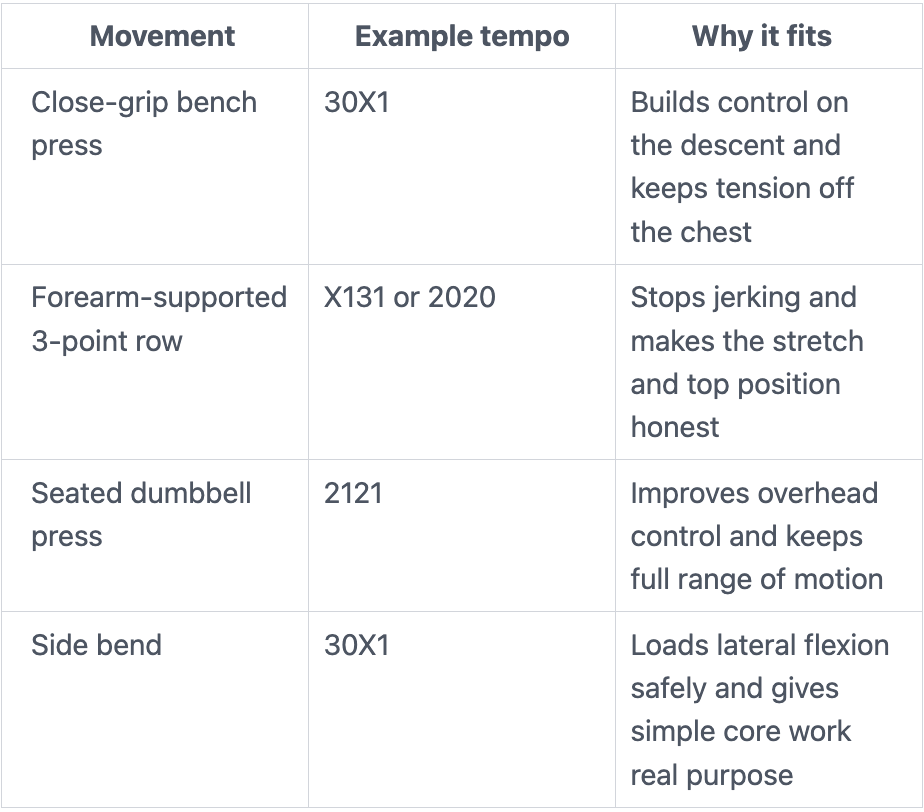
MovementExample tempoWhy it fitsClose-grip bench press30X1Builds control on the descent and keeps tension off the chestForearm-supported 3-point rowX131 or 2020Stops jerking and makes the stretch and top position honestSeated dumbbell press2121Improves overhead control and keeps full range of motionSide bend30X1Loads lateral flexion safely and gives simple core work real purpose
The bench press example was a good one because most lifters lose control in the last part of the descent or bounce off the chest. A slower eccentric fixes that fast. The weight has to come down under control, which also limits ego loading.
Rows got a similar treatment, but for a different reason. Many people yank a dumbbell up and let it fall. A row tempo like X131 or 2020 makes the lifter own both ends of the rep. That means better tension, better positions, and less junk volume.
The seated dumbbell press sat later in the session because it was more accessory work than a main lift. Even then, tempo still mattered. A controlled press helps the lifter reach the shoulder, lock out overhead, and use that range instead of cutting it short. Persson also mentioned a smart variation here, using a slower tempo for the first few reps and then loosening it slightly on the last few. For a broader look at how tempo fits with sets and rest, this program design essentials video pairs well with that idea.
Lower-body tempo should match the movement
The lower-body day followed the same logic. The leg press is externally supported, so it allows more output than a squat. That also makes it easy to pile on load and fake depth. A 30X1 or 40X1 tempo keeps the range honest. Persson also liked brief paused reps, such as 22X1 in warm-ups, to help someone find the bottom position.
The dumbbell RDL called for slower eccentrics too, usually 30X1 or 31X1. That keeps tension in the hamstrings and stops lifters from rushing through the hinge. When someone has a history of back discomfort or fear around bending, a stricter tempo can make the pattern feel much safer.
Reverse lunges were different. Gallagher did not want heavy tempo work there because lunges need rhythm. The goal was control, not a robotic rep. Shorter eccentric guidance works well, as long as the knee is not slamming into the floor.
Seated hamstring curls landed at the other end of the spectrum. Because the machine removes complexity, the coach can be more exact. A 2121 tempo makes sense here because the lifter can focus on the hamstrings, hold good hip position, and keep tension the whole time.
On a full-body accessory day, tempo can relax a bit. A cable lat pulldown might still use 2121 or 3030, but pump work like curls and triceps extensions does not always need that much structure.
Final thoughts
The strongest idea from this session was simple: pick the movement first, then match the tempo to the goal, then decide on sets and reps. That order makes programming sharper.
A bench press, row, or hamstring curl does not become individualized because it has a creative name. It becomes individualized when the tempo matches the client's weak point, skill level, and training goal.
For the full pathway into this kind of program design, look at the OPEX Method Mentorship.
Connect with the coaches
Brandon Gallagher:Brandon’s Instagram (@bgperform_)
Daniel Persson:Daniel’s Instagram (@danielcapersson)
Join us live on Tuesdays mornings 11:30am EST on the OPEX YouTube Channel
Start your free 14-day CoachRx trial and bring principled programming, habit tracking, and high-touch communication all in one seamless coaching command center.
