

Lifestyle Prescription for Real Results (Behind the Design)

Most people spend 1 hour training and then wonder why the other 23 hours keep canceling out their progress. That's the gap this episode of Behind the Design focuses on, not perfect sets and reps, but lifestyle prescription and behavior change that actually holds up in real life.
OPEX coaches Daniel Persson and Brandon Gallagher walk through how they set lifestyle priorities, how they progress nutrition without overwhelming clients, and how they use wearables and dashboards to support better coaching decisions (without letting a device "run the show").
Why lifestyle matters more than a perfect program
The "23 hours" that decide your results
It's easy to get obsessed with writing the perfect training plan. Coaches like training, clients like training, and it feels productive. Still, training is often the smallest slice of the week. If the rest of life is out of control, stress is high, sleep is low, food decisions are rushed, and movement only happens inside the gym, then even a great program hits a ceiling.
That's why this conversation keeps coming back to lifestyle design. The goal isn't to downplay training. It's to remember that training sits inside a larger system. When that system breaks down, the plan usually gets blamed first, even when the program isn't the main issue.
Brandon makes a useful comparison: good lifestyle coaching should work the same way good training does. You build a system that works in the "worst of times," and then it works even better when life is smooth. In other words, the goal is not a perfect week. The goal is a repeatable week.
A big part of that is resisting the urge to jump to advanced tactics because they sound "serious." People love talking about meal timing and exact macros. Meanwhile, the basics (sleep, sunlight, daily movement, simple food habits) get skipped, even though they often drive the biggest change.
Habit goals vs outcome goals (and why both matter)
Daniel frames goal setting in two buckets: habit goals and outcome goals. Outcome goals aren't "bad," but habit goals usually create the long-term win, especially for lifestyle-focused clients.
Here's the difference in a simple way:
Goal typeWhat it focuses onExampleHabit goalDaily behaviors and decisionsMove daily, plan tomorrow's mealsOutcome goalA result you're chasingDrop 5 kilos
Outcome goals can create motivation, but habits create traction. Daniel's coaching bias is to build most goals around behaviors because they're more sustainable and they give a client direction even when life gets messy.
That also explains why he moved away from strict diet plans over time. If a strict plan "worked," but you can't keep it going, then it didn't really solve the problem. A better question is the one Daniel asks clients who swear by the last diet they did: if it worked so well, why aren't you still doing it?
A plan that only works when life is calm isn't a plan, it's a temporary phase.
Progressing lifestyle like you progress training
Start with Basic Lifestyle Guidelines (simple, not easy)
Daniel's starting point is the Basic Lifestyle Guidelines (BLGs). They sound almost too simple, which is exactly why people ignore them. Clients sometimes want the secret recipe, and BLGs don't feel like a secret.
Still, BLGs are the base layer that makes everything else easier:
Sleep enough
See the sun daily
Move every day
Drink water
Eat quality food
The pushback is predictable: "That's too basic." The response is also simple: are you doing it consistently? If the answer is no, then complexity is just a distraction.
Brandon ties this to a coaching reality that shows up in the gym all the time. You wouldn't put a brand-new client under a barbell and ask for a heavy back squat on day one. First, you teach the pattern. You build awareness. You progress the challenge. Lifestyle works the same way. If someone can't consistently sleep, walk, and eat decent meals, then jumping straight to macros and timing is like handing them an advanced program before they can do the basics well.
This BLG layer also gives you a place to return to. If a client travels, has a stressful month, or needs to stop tracking for a bit, the foundation still holds. That matters because long-term progress requires flexibility, not rigid rules.
Fuel: real food first, macros when the goal calls for it
After BLGs, Daniel moves into "fuel." This is where food quality stays central, but the conversation can expand into macronutrients when it fits the client and the goal.
If performance is the priority, macros can help. If a client trains hard, trains more often, or needs to support recovery, then adjusting protein, carbs, and fats becomes more relevant. The important detail is the order of operations. Most people want to start here, but many haven't built the basic skills that make fueling work.
Brandon points out a practical blind spot: people want macro targets, but they haven't learned the basics of food behavior. Buying food, prepping food, storing it safely, and understanding simple differences in choices (like different fat percentages in ground beef) all affect whether a plan is realistic. A coach can write perfect targets, but if the client can't cook, has limited access to food options, or doesn't plan ahead, the plan becomes stressful fast.
They also talk about a common failure mode in gyms: new clients get thrown into macro plans immediately, run them hard for months, then plateau. Often, they never built awareness of what they eat or why they eat it. They just learn to hit numbers. That's a shaky base for long-term progress.
Timing: the smallest lever (and the most overhyped)
The final layer Daniel mentions is timing, when you eat certain things, especially around training. Timing matters more for high performers and athletes, for example, someone training in the morning and again later in the day who needs to recover and refuel between sessions.
For most people, though, timing is a small lever compared to BLGs and fuel quality. It gets a lot of attention because it sounds scientific and looks good on social media.
If you sleep 5 hours, never see sunlight, and sit all day, protein shake timing won't save the result.
That example is blunt, but it's useful. Coaches hear questions like "Should I have my shake 30 minutes after training or 90?" while the fundamentals are still missing. The better coaching move is to bring the focus back to the basics that actually change the outcome.
Wearables and health data without the noise
Real talk on Whoop, Oura, Garmin, and Apple Watch
Both coaches have tried multiple wearables, and their experiences are pretty balanced. The tools can help, but they're not magic, and they can mess with people's heads if used the wrong way.
Brandon has used Whoop, an Oura Ring, Garmin, and Apple Watch. He liked Whoop overall, although he hated that it didn't show the time. He also noticed mismatches between the score and his real experience, days where it said he wasn't recovered but he felt great, or the opposite. The Oura Ring was his favorite for sleep insights, but it wasn't practical for barbell training because of how it feels on the hand.
Daniel's personal use has been mostly Garmin and Polar watches, although he has clients using Oura and other trackers.
The shared theme is important: wearables can teach awareness, but they can also tempt people to outsource their self-awareness to a device. Coaches still need the human check-in: how do you actually feel?
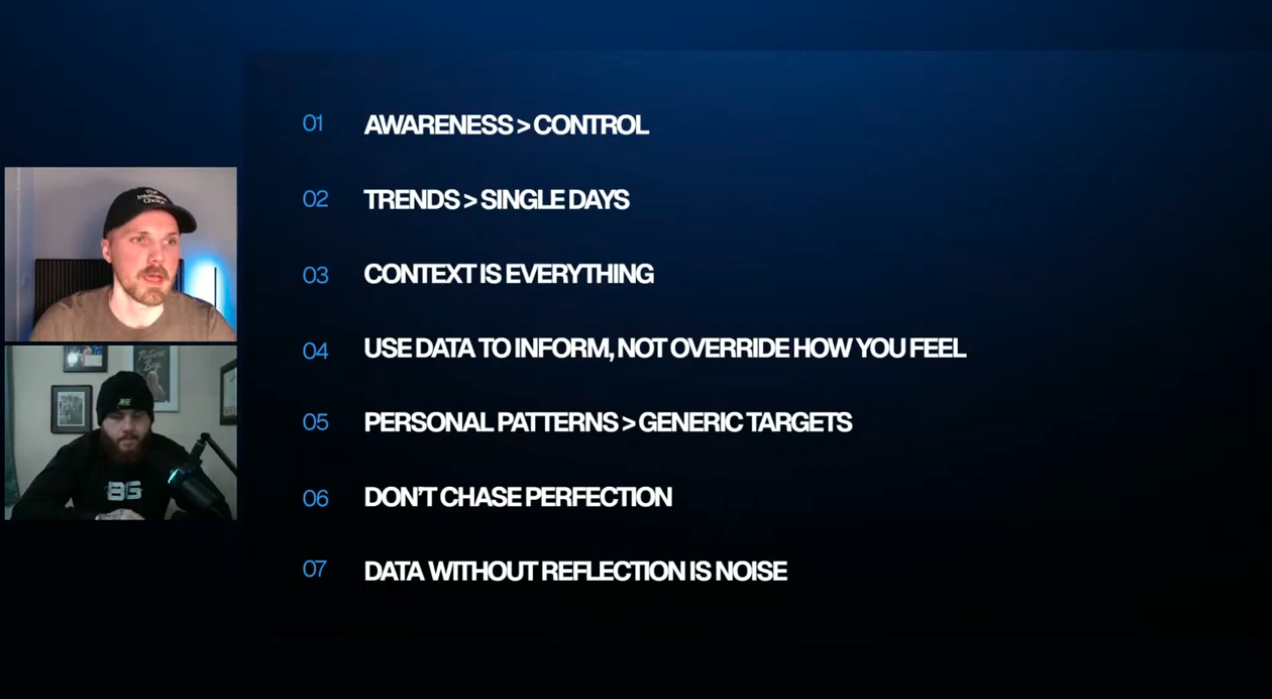
Seven principles for using fitness data with intent
Daniel laid out a simple set of principles he uses to keep data useful and keep coaching human. The point isn't to collect more numbers. The point is to collect the right numbers, then connect them to better decisions.
Choose awareness over control: Wearables shouldn't dictate what you can and can't do. They should help you notice patterns.
Look for trends, not single days: Most devices have some inaccuracy. The value is the direction over weeks, not one weird night.
Keep context front and center: A sick kid, travel, stress at work, and late nights all matter. Data only makes sense in real life.
Use data to inform, not override feel: Ask the client how they slept. Ask how they feel. Then use the numbers as support.
Focus on personal patterns, not generic targets: "What's a good HRV?" isn't the best question. A better one is, "What's normal for you, and what's changing over time?"
Don't chase perfection: Consistently good beats occasionally perfect. Tracking "bad" days can still teach you something.
Reflect, or it's just noise: If someone tracks sleep and recovery but never changes any habits, the data becomes clutter, not clarity.
Brandon adds a coaching warning from the athlete side: some high-level athletes avoid seeing the data because it changes their mindset. If a device shows a "red day," it can create doubt, even when the athlete feels ready to perform. In those cases, a coach may still want the data, but might not want the athlete staring at it all day.
If you want to try the same kind of setup shown in the episode, Daniel references using dashboards inside CoachRx. You can start with the CoachRx free trial and explore the lifestyle tools and integrations.
A simple nutrition progression that actually sticks (inside CoachRx)
Week 1: planning as the first "nutrition habit"
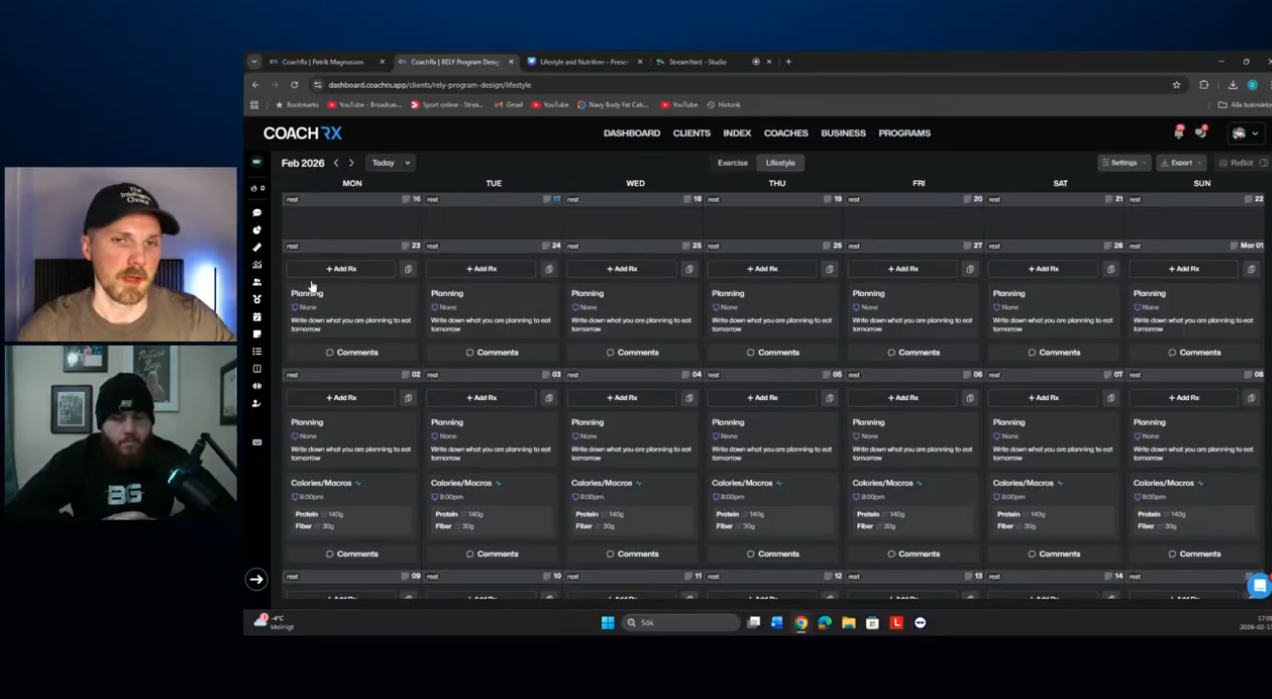
Daniel shared a real example of how he starts nutrition coaching in the CoachRx lifestyle calendar, and it starts with something many people skip: planning.
For the first week, the habit is straightforward: write down what you plan to eat tomorrow. No macro tracker required. It can be simple free text.
This does a few things at once:
It avoids overwhelm because the client only has one or two habits at first. It creates a "look ahead" skill, which supports groceries, prep, and fewer rushed decisions. It also gives the coach an honest picture of the client's baseline without forcing precision too soon.
Another subtle win is what people choose to write down. When someone has to plan tomorrow's meals, they often make more conscious choices. Most people don't proudly write, "pizza, burgers, donuts" as a plan, even if that's what they sometimes end up doing. The act of planning nudges better decisions without a big fight.
Brandon backs this up with his own approach. He likes starting with food logs that are descriptive, not numeric. "Eggs for breakfast, turkey sandwich for lunch, burrito for dinner" is enough to spot patterns. After that, coaching gets more specific. You can ask why snacks show up, whether stress drives late-night eating, or whether social settings push certain choices.
Add protein and fiber, then consider calories or macros
Once planning becomes consistent, Daniel often progresses toward targets that improve food quality without creating the feeling of constant restriction.
In the example he shared, the next step was protein and fiber targets. The client struggled to hit 140 grams of protein at first, so they kept the target, tweaked the approach, and built the habit. That "add first" approach matters. Many coaches start by taking foods away. Daniel prefers adding the right things in, because it changes the client's experience. It often feels less restrictive, even though the result can still be a calorie decrease.
They also touch on an important mindset for fat loss: if some restriction is needed, try to find the version that feels least restrictive for that person. One client might love macros because it allows flexibility. Another might do great with three meals a day and protein at each meal, no tracking needed.
If the client does move toward macros and calories, CoachRx can calculate macros automatically or the coach can set them manually. Daniel gives an example of setting a daily target like 2,400 calories.
This "levels" approach also makes it easier to pull back when needed. On vacation, for example, a client can stop tracking and focus on BLGs again, without feeling lost.
For coaches building these skills through education, the episode also mentions the OPEX Method Mentorship, especially for those who tend to focus only on program design and want to sharpen lifestyle coaching too.
Dashboards that sharpen coaching decisions (without losing the relationship)
How Daniel uses data in consultations
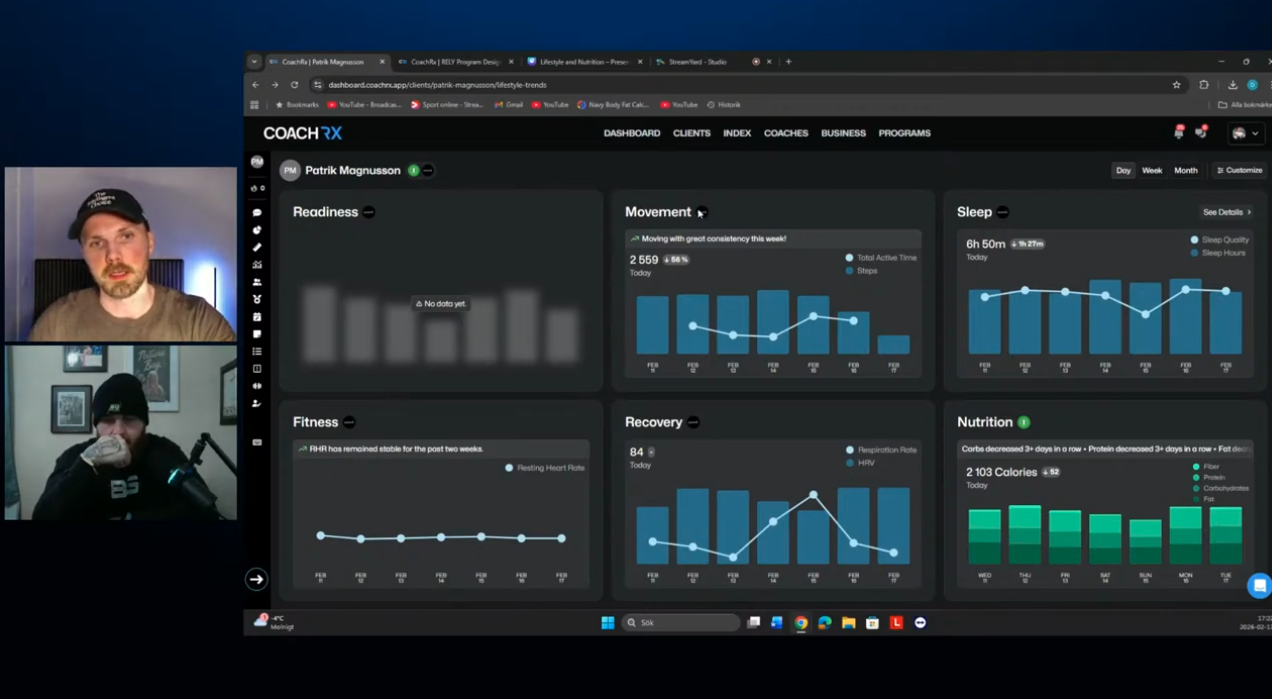
Daniel pulled up a client dashboard in CoachRx to show what he reviews during consults. With integrations like Garmin, he can see movement, sleep, recovery, and fitness trends. Nutrition data can also appear if the client uses a connected nutrition app.
He does monthly consultations for many clients (and weekly for some), and he likes having the month in view. That makes it easier to compare the plan, the lifestyle inputs, and the results, without guessing.
One key point: Daniel asks clients to connect wearables mostly for the coach's visibility and better prescription decisions, not because he expects the client to analyze trends or self-correct. He treats it like training design. The coach stays responsible for interpreting the information and making changes.
Brandon explains why that matters. Coaches often assume a program needs changing when a client stalls. Many times, the program is fine, but sleep is consistently under five hours, steps are low, and food quality is inconsistent. When you can see those patterns, you can adjust the lifestyle side without constantly rewriting training.
Data also helps a coach stay present. If sleep suddenly drops, that's a cue to ask, "Is anything going on?" It opens the door to real conversations about stress, life changes, and priorities, without making the client feel judged.
From the client side, Daniel says feedback has been positive because people like having everything in one place. Less app hopping means fewer lost details and less friction.
If you want to connect with the coaches featured in the episode, you can find them here: Brandon Gallagher on Instagram and Daniel Persson on Instagram.
Conclusion
Lifestyle prescription works because it respects reality: training is only a small part of the week, and habits drive the result. Start with Basic Lifestyle Guidelines, build food habits in levels, and use wearables for awareness and better decisions, not as a boss on your wrist. If you're coaching, tools like the CoachRx lifestyle calendar and dashboards can raise the quality of your conversations without replacing the relationship. Keep it simple, then earn the right to get fancy.
For coaches who want to see how programs are delivered and tracked, OPEX also shared a CoachRx free trial and details on OPEX Method Mentorship.
The best question to leave with is simple: does your plan help the fighter recover, repeat high output, and keep improving, or does it just make them tired? That answer usually tells you whether the peak is heading in the right direction.
Connect with the coaches
Brandon Gallagher: Brandon’s Instagram (@bgperform_)
Daniel Persson: Daniel’s Instagram (@danielcapersson)
Join us live on Tuesdays mornings 10:30am EST on the OPEX YouTube Channel
Start your free 14-day CoachRx trial and bring principled programming, habit tracking, and high-touch communication all in one seamless coaching command center.
