

Strict Press Faults and Fixes With OPEX Coaches

A bad strict press rarely starts at the shoulder. When the press breaks down, it often exposes issues in the rib cage, core, scapula, and even hip position.
That was the core idea in this OPEX Fitness discussion with coaches Brandon Gallagher and Daniel Persson. Their point was simple: the strict press matters, but it only works well when a lot of other pieces are already doing their job.
Why the strict press tells the truth about your movement
This episode picked up where the previous strict press conversation left off. Last time, the focus was progressions. This time, Brandon and Daniel got into faults, fixes, and the accessory work that helps people earn a better overhead position.
What stood out most was how both coaches framed the movement. Daniel described the overhead press as almost a movement assessment on its own. Brandon took that one step further and said it feels like the last piece of the puzzle. If everything else in the body is working well, the overhead press usually cleans itself up.
"If you can't properly overhead press, there's probably other areas in the body that you need to look at."
That idea changes how you program it. The strict press is still valuable for health and performance. However, it isn't something to force early, and it isn't something to include just because it always shows up in templates. Daniel made that point clearly: every exercise in a program needs a reason.
Client experience matters here too. If someone struggles overhead, piling more overhead work on top of that struggle can turn training into a bad experience. A coach still needs to think about stimulus, movement quality, and long-term progress. At the same time, the person doing the training has to feel set up for success.
Brandon also touched on a point that applies far beyond pressing. Early in a person's training life, you can get away with more general work. As training age grows, that stops working as well. The more adapted someone becomes, the more each lift in the program needs a clear job.
That is why the strict press can be such a useful lens for coaches. It shows whether the person can organize the rib cage, keep the trunk stacked, control the scapula, and move overhead without cheating the position. When those things are in place, the lift looks clean. When they are not, the body usually tells on itself.
If you want to keep up with the coaches outside the episode, here are their Instagram pages, Brandon Gallagher's @bgperform_ and Daniel Persson's @danielcapersson.
The arched-back fault is usually the first red flag
The first big fault both coaches circled back to was the arched back. You see it when someone starts pressing overhead and, instead of keeping the trunk stacked, the chest lifts toward the ceiling and the rib cage flares. The shoulder angle changes, so the movement stops being a clean overhead press.
In rough reps, the athlete is no longer challenging true overhead range. They are changing body position so the press acts more like an incline bench, or in severe cases, something close to a standing flat bench. The weight still goes up, but the movement isn't doing what it is supposed to do.
The same arch can come from two different problems
Daniel made an important distinction here. You have to figure out why the arch is happening.
One reason is limited shoulder mobility. If the athlete cannot get the shoulder into a strong vertical position, the body solves the problem by arching the spine and opening the rib cage. That lets the load move into a more stable line, but it hides the real limitation.
The second reason is poor coordination in the core and trunk. In that case, the athlete may have enough shoulder range, but they cannot organize the rib cage and pelvis well enough to hold position while the arm moves overhead. The fault looks the same, yet the fix is different.
That matters because generic "fix your overhead press" advice often misses the mark. A person searches for one drill online, copies it, and then wonders why nothing changes. Daniel's point was that the fault you see is only part of the story. The cause tells you what to do next.
Brandon added another layer. He often sees the arch tied to weak awareness of pelvic position and trunk stacking, not some grand posture problem that needs to be "corrected" all day. His point was sharp: the goal isn't to walk around in one perfect shape. The goal is to know how to get into the right position when the task calls for it.
The drills they use to rebuild a stacked press
Brandon starts even earlier than the press itself. He likes breathing drills on the floor, often with the feet up on a wall at 90 degrees or set on a bench in a hook-lying position. From there, the athlete takes big inhales, then long full exhales, and learns what a stacked torso feels like.
That full exhale matters because it helps the athlete feel the abs turn on without forcing a crunch. It teaches rib cage position from a stable setup with plenty of contact points. For Brandon, that is the easiest place to build awareness before adding movement.
Daniel's first choice is often the dead hang. He likes the isometric nature of it because nothing is moving except the athlete's effort to hold shape. That makes it easier to coach rib cage position, overhead length, and body control. He also mentioned that he tries to accumulate a solid amount of dead hang time across the week for his own shoulder health.
From there, both coaches like pullovers. Daniel mentioned dumbbell pullovers, and Brandon likes both dumbbell and cable versions. The point is not to move heavy weight. The point is to keep the rib cage down while the arms travel overhead. If the athlete grabs a load that is too heavy, the chest pops up, the back arches, and the drill stops doing its job.
Brandon also brought up banded dead bugs with straight arms. That gives the athlete another way to feel neutral trunk position while the limbs move. Daniel uses that kind of early-session work to create what he called "references," especially because he coaches remotely. If a client feels the right shape in a dead hang or pullover first, it is easier to coach the same shape later in the press.
Brandon's own upper-body sessions often start the same way: breathing work, some thoracic rotation, then a pullover variation before the main pressing. The idea isn't to turn the warm-up into a workout. It is to build the position that the rest of the session depends on.
Elbow flare and wrist drift change the press fast
The second big fault Brandon highlighted was elbow and wrist position. This one often shows up on the way down from the top of the press, or once fatigue starts to build. The dumbbell is overhead, but then the elbow starts to drift out to the side and the wrist stops stacking cleanly over it.
When that happens, the shoulder loses a stronger line of support. The scapula stops doing its share of the work, and the press asks more from the delt in a less stable position. Brandon wants the elbow to stay more organized under the hand, especially during the lowering phase, because that gives the shoulder better support and a better path to produce force.
This fault also tells the coach something useful. If it only appears after several reps, it may be less about the person's first-rep skill and more about how they hold scapular control under fatigue.
Two accessories they keep coming back to
Brandon's favorite fix here is the eccentric push press. The athlete uses the legs to drive the weight overhead, then lowers it under control. That matters because the person can handle more load on the way down than they can strict press on the way up.
In practice, that gives the athlete more time under tension in the exact part of the lift where the elbow and shoulder often fall apart. Brandon likes it in higher rep sets, often around 8 to 12 reps, because the loss of position tends to show itself once fatigue kicks in. He said this drill helped him a lot during the years when he was pushing handstand push-ups, Olympic lifts, and shoulder capacity hard. At one point, he was lowering 90 lb dumbbells under control, and he said his shoulders felt great.
The second drill is the bottoms-up kettlebell press. With the bell flipped upside down, the athlete has to control a less stable load while moving through the press. Brandon likes it as an awareness tool. It teaches the shoulder to organize itself fast.
Daniel agreed with that use, but he also gave a useful warning. Too many people treat the bottoms-up press like a main strength builder. He doesn't. If someone already has a good overhead position, loading a stability drill harder and harder only limits force output.
This quick comparison shows how they framed both drills:
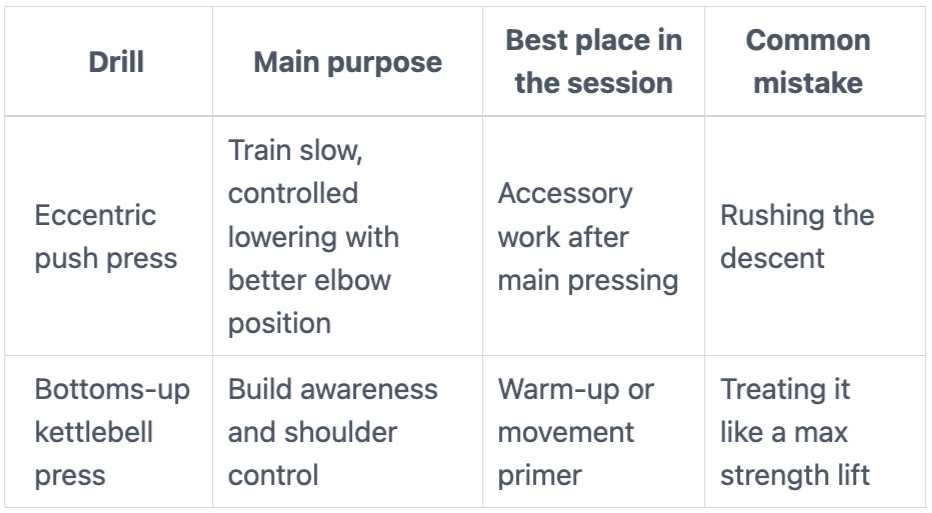
The takeaway is simple. Use the bottoms-up press to feel the position. Use the eccentric push press to load the position. If the goal is a stronger strict press, the strict press still needs real strength work too.
Good program design keeps the strict press in context
A big part of this episode was not about faults at all. It was about how coaches think.
Daniel pushed back against all-or-nothing thinking around the strict press. Asking whether an exercise "should" be in a program can become too rigid, too fast. A better question is why it is in the program for this person, right now.
"Everything you put into the program, you should have a reason for."
That becomes more important as training age goes up. Early on, a person can improve from a lot of inputs. With time, the coach needs a cleaner answer for every slot in the week. The strict press may be the goal, or it may be a later step in the goal. Either way, it belongs in the program because it fits the person and the phase, not because it is a staple lift on paper.
Brandon put this in practical terms. Sometimes week one work does not look like a strict press at all. It may be breathing drills, pullovers, dead bugs, or supported pressing variations. Those exercises are still part of the path. The coach has to see what the client can become before the movement is ready to show up fully.
Client experience matters too. Daniel said that if a client already struggles with overhead pressing, asking them to do a lot of overhead pressing is usually poor programming. The right answer may be a supported progression, a smaller range, or a different pattern for a while.
He also made a point that many coaches forget: empathy matters as much as principles. If a client wants a strict press goal in four weeks, the coach should care about that goal, not dismiss it. Then the coach explains what has to happen first. That approach keeps the relationship strong.
Brandon agreed, and Daniel added one more helpful thought. If the client loves leaving the gym sweaty, there is room to respect that. A few minutes of bike work or burpees at the end can fit, as long as the coach protects the bigger direction of the program.
Why motor control beats chasing calorie burn
This part of the conversation widened out beyond pressing, and it was one of the best sections in the episode.
Brandon said many people still judge a workout by how many calories it burns or how wrecked they feel afterward. He pushed against that idea. Training is also supposed to improve movement. If movement gets better, the person can train harder, handle more, and stay healthier for longer.
That is why so much of the "boring" accessory work matters. Dead hangs do not feel impressive. Breathing drills do not light up a heart-rate monitor. Pullovers with a light dumbbell won't look intense on social media. Still, those pieces improve the positions that make hard training possible later.
Daniel framed it as an investment in future training years. If a client skips that work and forces big movements with bad positions, they may feel like they trained hard today. Four weeks later, they may be dealing with overuse, pain, or a stall that could have been avoided.
He tied that idea to minimal training volume too. If a person moves well, each rep has more value. Then warm-ups can shrink, force output can climb, and the whole session becomes more efficient.
Daniel gave a great example from his own training. After not touching the clean for about a year, he worked up with five vertical jumps, a couple of warm-up sets, then singles at 100 kg, 110 kg, and 120 kg. That only works because the movement skill is already there. He has spent years building coordination, so he can call on it later.
That is what these coaches were really getting at. Good motor control is not fluff. It is part of long-term performance. If you want the strict press to improve, the smaller pieces are often where that progress starts.
Frozen shoulder, pain, and where coaching should stop
A viewer question brought the conversation into an area a lot of coaches need to hear more often: frozen shoulder, pain, and scope of practice.
Daniel's answer was clear. If something hurts, he first looks at which movement or pattern triggers it. Then he reduces volume or removes the movement for a couple of weeks and watches what changes. If that does not help, he wants the client to go get it checked by the right professional.
"It's okay to not know."
That line matters. Daniel's point was not that coaches should ignore pain. His point was that coaches should respect the edge of their role. A coach is a coach. Unless that person also has clinical training, they are not a doctor or physio. Brandon agreed and said he has plenty of experience rehabbing his own issues, but he still will not go past basic decisions inside programming.
Both coaches stressed the value of referral networks. Daniel works with a trusted physio. Brandon has a chiropractor in the same gym and talks with him often. That gives them a way to pass the client to someone better equipped, then bring the clinical feedback back into training.
If the client has been cleared to train, Daniel described a simple rebuild path that often works well:
Start with isometrics and positions that do not aggravate the shoulder.
Move to floor press if it feels good and monitor the response.
Progress to incline bench, then landmine work, only if symptoms stay calm.
Step back when needed, then retry after more time at the previous level.
That step-back piece matters. Daniel mentioned a client who had to return to floor press for four more weeks before incline bench worked. That is still progress. It is the same idea they use everywhere else in programming: find the level the person can own, then build from there.
Brandon added one more useful boundary. If the solution starts to sound like hands-on treatment, manual release, or anything close to therapy, it is outside the coach's lane. That line protects the client and the coach.
For coaches who want more structure around this kind of thinking, OPEX also linked the OPEX Method Mentorship, which is the current mentorship enrollment they mentioned during the episode.
A few quick extras from the episode
Near the end, Brandon squeezed in one more strict press note: reverse shrugs. He likes them for lockout work and scapular depression. They connect back to a theme from both this episode and the last one. A clean press depends on how well the scapula moves and stabilizes, not only on how strong the shoulder feels.
The episode also included a few updates from the OPEX side. Daniel said next week's conversation would likely touch on a recent program design that mixed running and CrossFit, along with reflections from his trip to Paris for semifinals. Brandon said he would be out next week, and they also joked about bringing Spencer on as a guest, which fit the point they made early in the show that even coaches benefit from having coaches.
For coaches looking at the business side, they mentioned a May 18 workshop on business modeling and forecasting. Brandon framed it for coaches who are trying to figure out whether this can be a sustainable long-term career, especially around income, retention, profitability, and core business metrics. He also noted that Carl had recently revisited the forecasting tool behind that workshop.
They also pointed listeners toward a few OPEX resources:
Brandon Gallagher on Instagram at @bgperform_
Daniel Persson on Instagram at @danielcapersson
Final thoughts
The best takeaway from this discussion is simple: the strict press is rarely only about the press. When it breaks down, it usually points to something upstream, trunk position, scapular control, shoulder range, or how the program was built in the first place.
That is why Brandon and Daniel kept returning to the same theme. Better pressing comes from better positions, clear intent, and patience with progressions. The bar going overhead is the end result, not the starting point.
If the movement looks off, the fix may be smaller, slower, and less flashy than most people expect. It is still the work that makes the heavy press possible.
Connect with the coaches
Brandon Gallagher:Brandon’s Instagram (@bgperform_)
Daniel Persson:Daniel’s Instagram (@danielcapersson)
Join us live on Tuesdays mornings 11:30am EST on the OPEX YouTube Channel
Start your free 14-day CoachRx trial and bring principled programming, habit tracking, and high-touch communication all in one seamless coaching command center.
