

Conditioning Progressions for Air Bike, Rowing, Running, and MMA

Most conditioning plans fall apart because they repeat the test instead of building toward it.
In this session of OPEX Fitness' Behind the Design, coaches Daniel Persson and Brandon Gallagher move past theory and show real conditioning progressions. The common thread is pace. When athletes know what to hold, what to repeat, and what to build each week, conditioning stops feeling random.
The examples below show how that looks in practice.
Good conditioning starts with clear intent
The running joke in the conversation was that the show could be called "It depends." That wasn't a throwaway line. It was the point. Good coaching changes with the person in front of you, their goals, their training age, their sport, and even their tolerance for boredom on a machine.
Still, the principles stay steady.
Persson and Gallagher kept coming back to the same questions:
How long do you want the athlete to work?
At what intensity?
What pace can they repeat?
Which movement pattern or modality makes sense for that person right now?
Rowing has a skill component. So does biking, skiing, and running. But the bigger coaching idea is portable. You can swap the machine and keep the logic.
A simple framework showed up again and again:
Start with a test or a benchmark.
Give the athlete a pace reference they can understand.
Progress time, rest, volume, or intensity with a clear reason.
That last piece is where many programs miss. Strength work often gets tidy percentages and set progressions. Conditioning often gets vague suffering.
Persson and Gallagher argued for the opposite. Conditioning deserves the same level of thought, because simple cyclical work can teach pace, breathing control, and repeatability in a way that carries into sport and daily training.
OPEX also pointed viewers toward resources like the OPEX Method Mentorship, where this kind of individual design gets broken down in more detail.
The air bike: using a 10-minute test to teach pace
Persson's first example centered on a 10-minute air bike test, a benchmark many OPEX coaches already know well. The smart move wasn't to keep repeating the same ugly 10-minute effort. Instead, he split the same time domain into intervals, then stretched those intervals out week by week while asking the athlete to keep the same output.
That approach does two things at once. First, it gives the athlete more chances to hit the right pace. Second, it shows them what they can do when rest is available, which builds confidence for the retest. Here's how the progression looked:
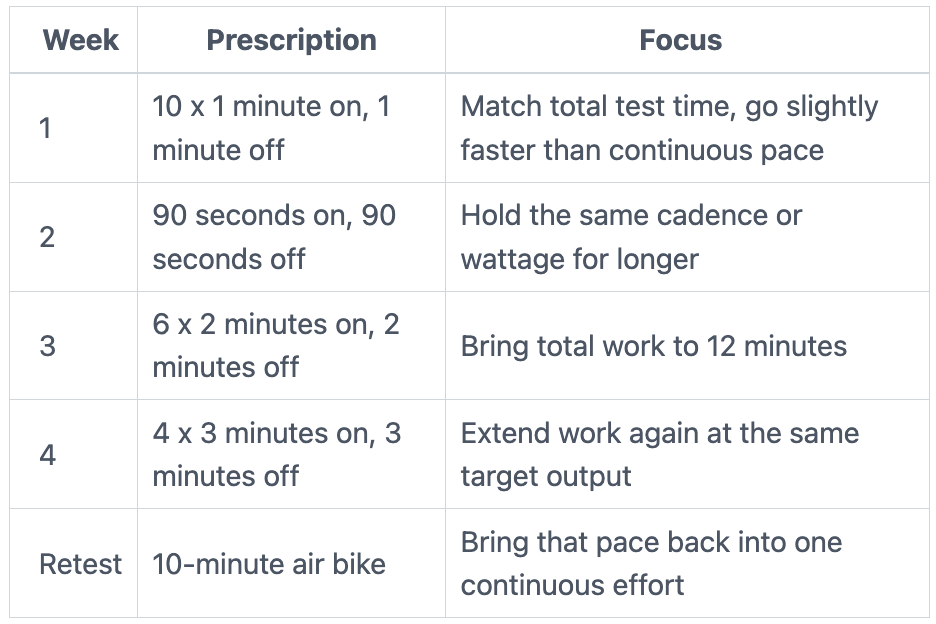
The athlete in Persson's example was chasing 150 calories. Early in the progression, she could hit 15 calories in each one-minute interval with one minute of rest. By the time she returned to the continuous test, she landed at 148 calories. She fell two calories short of the number she wanted, but the improvement was still obvious and easy to explain.
Breaking a hard effort into repeatable intervals often reveals the pace an athlete can grow into, not just the pace they can survive today.
Gallagher made a strong point here about pacing. On a run, most people know they can't sprint the first 30 seconds of a 10-minute effort. On an air bike, newer athletes often have no such reference. They go out too hard, then fall apart. That's why pacing matters so much. It gives the athlete something concrete to learn, not just pain to tolerate.
This is also where tracking matters. Persson mentioned saving time trials and conditioning pieces in a library, which is one reason tools like the CoachRx free trial can help coaches keep benchmarks and progressions organized.
Rowing progressions: split the 2K, then build beyond it
For rowing, Persson shared a progression he has used for years, and the logic is almost disarmingly simple. Start with a 2K row test. Then divide the total distance by four. That gives you 500-meter intervals. From there, ask the athlete to row those 500s at their 2K pace and rest two minutes between efforts.
Start with 500-meter repeats at 2K pace
The first week might be five or six sets. That already pushes the athlete past the total distance of the test while keeping the pace anchored to something real. The next week might move to eight sets. Then ten. After that, the coach can either pull volume down for an easier week or start the next wave at a slightly faster pace, often five to 10 seconds faster per 500 meters. The beauty of this setup is how clear it is. The athlete knows the pace. The coach knows the total volume. Progress becomes visible fast. A 2K row covers 2,000 meters. Six 500-meter repeats bring total work to 3,000 meters. Eight sets reach 4,000. Ten sets hit 5,000. The athlete isn't only rehearsing the test. They're building a bigger engine around it. Gallagher liked that part of the progression because it shows what real conditioning design looks like. You don't need fancy language. You need a benchmark, a pace, and a reason to add work.
Know when linear progression stops working
Persson also made an important coaching point. Linear progressions work well until they don't. A newer athlete might handle a simple weekly bump in volume. A highly trained rower might not. He compared it to strength work. A beginner can often add a little weight to a squat every week.
The strongest powerlifters in the world can't keep doing that forever. Rowing works the same way. If an athlete is mature in that movement and time domain, asking them to jump from six hard 500s to eight at 2K pace may be too large a jump. That's where coaching judgment matters. You might start with five sets instead of six. You might add one set per week instead of two.
You might keep the set count steady and wave intensity instead. The principle doesn't change, but the progression does.
Make longer aerobic work easier to stick with
Another smart detail came up when the coaches talked about newer or deconditioned clients. Sometimes 10 minutes on a rower or bike is hard for physical reasons. Other times, it's hard because it's boring or uncomfortable.
Persson gave a practical fix. One client had 10 minutes on the rower, but every two minutes she stepped off for four burpees over the rower before getting back on. The burpees didn't change the goal much. They kept her engaged. That matters more than some coaches want to admit. If the athlete hates the setup, the best progression on paper can still miss. In those cases, it often makes sense to build toward 10 continuous minutes first, then test, then split the test into intervals and build back out.
Running progressions that fit around strength work
Not every conditioning progression lives on a machine. Persson showed a running example built for a client who still wanted one foot in CrossFit, but had a bigger focus on strength and running. The weekly setup included two strength days using a condensed conjugate style split, one accessory and Olympic lifting day, and two run days. That detail matters because the run work wasn't designed in a vacuum. It had to fit around recovery and strength training.
One day for tough sustainable pace
On the first run day, Persson wanted the work to be slightly auto-regulated. The opening week used three sets of eight minutes at a tough sustainable pace, with three minutes of easy walking or spinning between efforts. The client's feedback told the story. He ran 4:12 on the first two sets, then dropped to 4:34 on the last. That said the opening pace was too fast to be called sustainable.
So the next week, Persson gave him three 10-minute efforts at 4:30 pace. The athlete handled that with no problem and reported that it felt great throughout.
Week three shifted again. The sets moved to four rounds of eight minutes at that same reference pace. Even then, the athlete could push slightly faster on the final sets. That's a small but strong example of what good coaching looks like. The first week reveals the truth. The second week cleans up the pace. The third week builds on something the athlete can repeat.
One day for conversational pace and faster repeats
The second run day worked from a different anchor. The athlete first established a conversational pace, then rested five minutes.
After that, he ran five sets of three minutes at 20 seconds per kilometer faster than that conversational pace, with two minutes of walking between efforts. In the next wave, Persson added another set.
Then he shifted the structure again to four sets of four minutes. The pattern stayed familiar while the work stretched out. This is one of the most useful takeaways from the whole discussion. Running progress doesn't always need a big race-specific plan to start.
Sometimes it needs a pace the athlete can feel and own. "Tough sustainable" and "conversational" aren't vague when the coach uses them well. They become anchors the athlete can build from.
Designing the pain session without turning it into chaos
Gallagher wanted to make a clean distinction between sustained conditioning and what he called pain work. A 10-minute bike test hurts, of course, but it still lives in a longer time domain with a pace to manage. Pain work is different.
The window is usually shorter, the output is higher, and the rest needs to be long enough for the athlete to hit true intensity again. That difference matters because many athletes confuse random suffering with good conditioning. They sprint until they're wrecked, then call it a training session. The coaches pushed back on that idea hard.
Short all-out air bike intervals
One example Persson shared used the air bike in very short efforts. The setup was every two minutes for five sets, with 10 seconds all out, then easy spinning or walking for the rest of the interval. After five sets, the athlete rested five minutes and repeated the block.
From there, the coach had two clean options. He could drag the time out, moving from 10 seconds to 12 and then 15. Or he could keep the duration steady and add sets or blocks. The point stayed the same. Short work only counts as short, hard work if the athlete goes all out. If they can chat through the rest period and feel ready early, the sprint likely wasn't hard enough.
Leg-draining mixed-modal work
Pain work can also show up in mixed-modal pieces. Persson gave one brutal example designed to light up the quads. In one version, the athlete did nine dumbbell high squat cleans straight into a sled push and then 30 hard seconds on a BikeErg set to damper 10. Each round lasted about 1:20 to 1:30 and left the legs burning.
The next week changed the pattern but kept the same target. It started with a 30-second wall sit, then three thrusters at 60 kilos, then a sled push, then the BikeErg. Total work time rose to around 1:40. The week after that nudged the work up again.
Placement matters with sessions like this. Persson said he often puts the hardest pain work near a rest day, because nobody needs to back squat right after a session that drains the quads that hard. Still, life matters too. Some athletes like their toughest training on weekends when stress is lower. Others want the end of the week lighter. The session has to fit the person.
Conditioning for combat athletes and mixed-modal sports
Gallagher brought in several examples from MMA, and they added an important layer to the conversation. Fight conditioning isn't a flat line. The athlete doesn't get a clean, steady output for five minutes. A round spikes and drops. A flurry on the feet, a takedown attempt, a hard scramble off the cage, then a few seconds to recover if the athlete can find them. CrossFit has a similar flavor, although the context is different. In both sports, the athlete has to recover in tiny windows and get back to work fast.
Sprint-rest-sprint for fight-specific bursts
One progression Gallagher liked late in camp paired the bike and the SkiErg. The athlete sprinted the bike for 10 seconds, rested 15 seconds to transition, then sprinted the SkiErg for 10 seconds. After that came enough rest to make the total cycle about two minutes. He often started with eight rounds.
Then he added rounds, or stretched the work to 12 seconds, or pushed certain athletes to 15 seconds if they handled that style well. This setup worked for a simple reason. The bike hammered the lower body. The SkiErg shifted more load to the upper body.
That allowed the athlete to keep output high across the pair while still practicing the burst-recover-burst pattern that shows up in a fight.
Gallagher's read was that fighters responded well to this because it felt familiar. Not because it looked exactly like the sport, but because the rhythm matched it. That is a useful distinction. Conditioning doesn't need to copy the sport frame by frame. It needs to build the qualities the sport keeps asking for.
Five-minute rounds and breathing under load
On the aerobic side, Gallagher often started with plain five-minute intervals for calories or distance on the bike, rower, SkiErg, or run. Four rounds was a common start. Five rounds made sense for longer fights.
Once that base was set, he liked a five-minute AMRAP that mixed cyclical work with awkward breathing positions. One version used 12 bike calories, a heavy slam ball carry for about 30 seconds, then a 30-second plank, repeating that sequence for the full round. That piece does more than make people tired.
The bike raises the heart rate. The slam ball carry compresses the chest and makes breathing harder. The plank adds more isometric tension. Then the athlete gets back on the bike and has to settle into a pace again while fatigued.
That skill matters in fighting. It matters in CrossFit too. Both sports ask athletes to breathe under load and recover without stopping. Persson added a useful wrinkle at the end of the discussion.
Closer to competition, coaches can mix intensity inside the same time block. For example, an athlete might hold a moderate pace on the bike, then sprint the final 10 seconds before moving into another task. That creates a sharper heart rate spike and forces the athlete to solve the next movement while still trying to regain control.
Final thoughts
The strongest lesson from these examples is simple: pace makes conditioning honest. Once the athlete has a real benchmark, the coach can stretch time, add volume, reduce rest, or raise intensity without turning the session into guesswork.
That is why a 10-minute bike test can become one-minute intervals, a 2K row can turn into waves of 500-meter repeats, and a five-minute fight round can become mixed work under fatigue. Good conditioning doesn't chase suffering for its own sake. It builds repeatable effort, then expands it.
Behind The Design is part of the CoachRx Podcast Network. If you want to organize session intent, review client comments, and check whether an athlete is hitting the right stimulus across exercise, nutrition, and lifestyle, you can try CoachRx free for 14 days.
For the full pathway into this kind of program design, look at the OPEX Method Mentorship.
Connect with the coaches
Brandon Gallagher:Brandon’s Instagram (@bgperform_)
Daniel Persson:Daniel’s Instagram (@danielcapersson)
Join us live on Tuesdays mornings 11:30am EST on the OPEX YouTube Channel
Start your free 14-day CoachRx trial and bring principled programming, habit tracking, and high-touch communication all in one seamless coaching command center.
