

Remote Coach Finances: Build Confidence With a Budget

Remote coaching can look simple until you have to decide what to do with the money. When your fixed costs are low, the cash left in your account can feel like a paycheck, even when your business still needs it.
That is where a lot of coaches get stuck. Financial confidence does not come from staring at your bank balance. It comes from knowing what you are building, what each expense supports, and when you will reinvest before emotion talks you out of it.
Daniel Persson and Brandon Gallagher framed this well in their OPEX Fitness conversation, and their ideas give remote coaches a cleaner way to budget, spend, and grow.
Why remote coaching money gets messy fast
A remote coaching business is attractive because it is light. You might only pay for coaching software, bookkeeping, an AI subscription, and maybe a website. Some coaches skip the site altogether and run the whole thing through Instagram and DMs.
That low overhead feels good at first. Then it creates a problem. If you are not careful, every dollar left over starts to feel like personal income instead of business capital.
Most coaches did not get into fitness because they wanted to handle budgets, pricing, bookkeeping, and marketing. They wanted to coach. They wanted to write better programs, help clients improve, and build real relationships. Still, the moment you run your own coaching business, all of those other jobs show up too.
In a low-overhead remote coaching business, unplanned cash can start to feel like a salary before the business is ready for you to take it.
That is why Persson kept coming back to one idea: you need to separate your role as the owner from your role as the coach. Even if you are the only person in the company, those are still two jobs. The coach delivers the service. The owner decides where money goes, how the business grows, and what the next investment needs to be.
A lot changes once you make that split in your head.
You stop treating every surplus dollar like take-home pay.
You start asking whether money should stay in the business a little longer.
You judge expenses by how they improve delivery, retention, pricing, or time.
You become more willing to invest in skills and systems that make the business stronger.
That shift matters because fear makes every decision feel personal. A business plan makes those same decisions easier to trust.
Build your budget around the business you want
Many people start budgeting backward. They look at the money they have, then try to make their plans fit the bank balance. That can work for paying bills, but it is a weak way to guide a business.
Persson's point was simple: a budget should be a roadmap, not a fence. It should connect your long-term vision to the actions you need to take now.
A better budgeting flow looks like this:
Start with vision. What are you trying to build? A high-touch individualized coaching practice? A lower-cost group offer? A solo business with freedom? A company that will one day include other coaches?
Define operations. What systems support that vision? That could mean software, scheduling, onboarding, check-ins, bookkeeping, or content systems.
Choose actions. What moves the business forward right now? Maybe it is better program design, cleaner marketing, stronger retention, or a better client experience.
Build the budget last. Once the first three are clear, your spending decisions have context.
This order matters because plenty of budgets are little more than last year's numbers plus a small increase. That style misses the point. A useful budget has a job. It should tell you whether a purchase belongs in the plan you are trying to build.
So the question changes. Instead of asking, "Can I afford this?" you ask, "What action does this investment support?"
That question leads to better answers. If a purchase supports the actions that support your operations that support your vision, it has a place. If it does not, it is probably noise.
For coaches who want a more formal planning model, this online fitness business plan guide is a helpful reference. The main idea stays the same, your numbers make more sense once the business direction is clear.
Use predetermined triggers so growth does not depend on mood
Remote coaching gives you freedom, but freedom does not come with deadlines. In a gym, you can usually see the next problem. Equipment breaks. The floor needs work. Scheduling gets crowded. Staffing becomes obvious.
Online, those signals are softer. Because of that, coaches often postpone important decisions. They keep using a clunky system. They delay raising prices. They talk themselves out of mentorship. They wait until the problem becomes painful.
Predetermined triggers fix that. You decide in advance what will happen when a certain condition is met. That way, you do not leave growth up to the emotion of the day.
This is what that can look like:
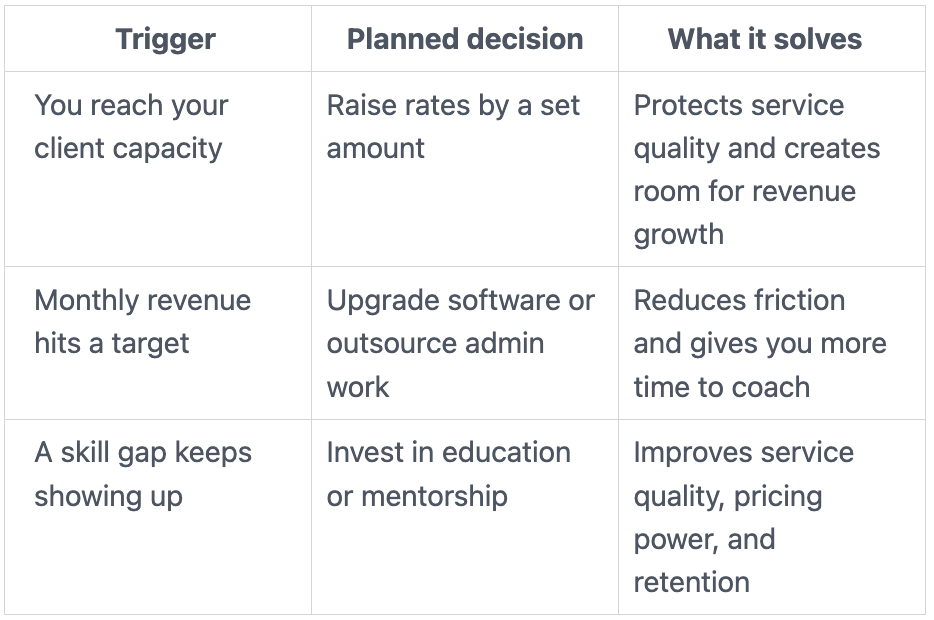
The point is not to create dozens of rules. The point is to remove hesitation when the next move becomes clear.
For example, if you are still running your business through spreadsheets and manual messages, a CoachRx free trial can be the kind of operational upgrade that saves time and removes friction. If the bigger issue is how you coach, deliver, and structure individualized service, the OPEX Method Mentorship fits the kind of reinvestment Persson was talking about.
This also changes how you look at certifications and courses. Education should not be a trophy. It should make your service better. That means better programming, stronger lifestyle coaching, clearer systems, more confidence with clients, and better retention over time.
A more expensive service only works when the client experience supports the price. That is why Persson tied education so closely to financial growth. If you improve your standards, your service becomes easier to keep, easier to explain, and easier to charge for.
Invest in the asset that matters most, your coaching skill
A better coach builds a better business
Persson talked about this in a very direct way. If you are the business, then improving yourself is one of the smartest investments you can make.
Money parked in the account may feel safe. Yet money used to improve your ability to coach can pay you back for years. Better judgment, stronger principles, and a better client experience are not easy to copy. Once you build those skills, they stay with you.
That is also why he spoke about taking as little as possible out of the business during growth phases. The goal was not to starve the business while waiting for magic. The goal was to keep enough money inside the business to improve the one asset that drives results, the coach.
Quality coaching has limits, and that is fine
One of the better parts of the conversation was the pushback against the idea that growth always means more clients.
Some coaches want a low-ticket model and a huge roster. That is fine if it matches the vision. Others want a smaller book of clients, higher service, and more attention per person. That is the OPEX-style path Persson and Gallagher kept coming back to, individualized coaching with real depth.
If that is your model, then capacity matters. You cannot coach 400 people at a high level and still give them the time and care that individualized design demands. In that case, growth may come through retention, pricing, better systems, and higher value per client, not a constant chase for more heads.
That is also why "I have helped thousands of clients" is not the only number that matters. Revenue per client matters. Retention matters. Quality matters.
Study what the business needs, not only what you enjoy
This may be the hardest point in the whole discussion. A coach can love program design and still need marketing help more than another programming course. A coach can care about coaching craft and still need better bookkeeping, better sales, or cleaner operations.
Your interests matter, but the business still has needs. If you plan to stay solo, those needs do not disappear. You either learn the basics, outsource pieces of the work, or use tools that reduce the load.
Persson made that clear with friction. If something in the business keeps draining time or energy, it is worth asking whether that job should be improved, outsourced, or learned properly.
A remote coaching business still needs structure
One reason remote coaching feels uncertain is that it does not hand you structure. You have to build it yourself.
That is true whether your goal is a full-time solo practice or a larger company with other coaches under your brand. The model changes, but the need for planning does not. You still need delivery systems. You still need marketing. You still need clean finances. You still need a reason for each expense.
This is where a lot of coaches get stuck in a loop. They tell themselves they will handle the money piece later. They say they will think about rates after they get a few more clients. They promise themselves they will clean up operations once things settle down. For most people, things do not settle down on their own.
Structure fixes that.
A written budget gives direction. Predetermined triggers remove delays. Better systems reduce wasted hours. Education improves pricing power and retention. Each of those pieces makes the business feel less random.
Gallagher made a useful point here too. Sometimes fear around spending is really a lack of clarity. If you know what the purchase is for and what result it should support, the decision gets easier. You are not throwing money into space and hoping it comes back. You are funding the next step on purpose.
That does not remove all risk, and it should not. Running a coaching business will always carry some uncertainty. Still, a coach with a plan handles that uncertainty better than a coach who treats every decision like a gut check.
OPEX also shared a few coach-focused updates
The financial discussion sat alongside a few OPEX updates that matter for coaches who want more support around their craft and business.
At the time of the conversation, OPEX Method was enrolling for a July 14 cohort, with enrollment closing July 10 and fewer than 20 spots left. The format included 10 weeks of mentorship focused on program design, lifestyle coaching, systems, methodology, individual design, plus two weeks of marketing content.
OPEX also said its live events were coming back after a post-COVID break. That included live workshops, meetups hosted by OPEX ambassadors around the world, and a four-day coaches retreat in Lisbon, Portugal, in November. The retreat was about halfway full when that update was shared.
Those details fit the larger point of the conversation. Coaches do better when they keep learning, get around peers, and spend time in rooms where standards are higher. Financial confidence is not only about numbers on a spreadsheet. It also comes from knowing where to go when you need help building the next level of your business.
Financial confidence comes from planned decisions
A remote coaching business looks simple on the surface. Underneath, it still needs clear decisions about pricing, operations, education, and reinvestment.
When your budget starts with vision and your spending follows pre-set triggers, money stops feeling random. Your business gets easier to trust because each dollar has a job.
Pick one trigger and write it down. Decide when you will raise rates, improve your systems, or invest in education. Confidence usually shows up before the purchase, not after it.
For the full pathway into this kind of program design, look at the OPEX Method Mentorship.
Connect with the coaches
Brandon Gallagher:Brandon’s Instagram (@bgperform_)
Daniel Persson:Daniel’s Instagram (@danielcapersson)
Join us live on Tuesdays mornings 11:30am EST on the OPEX YouTube Channel
Start your free 14-day CoachRx trial and bring principled programming, habit tracking, and high-touch communication all in one seamless coaching command center.
