

Maximal (Human) Potential
Frameworks with Carl Hardwick | CoachRx Podcast Network
Frameworks, Episode 47, with Carl Hardwick and James FitzGerald
A thirty-nine-year-old walks in. He has been training for the better part of twenty years. He is currently deconditioned and carrying more body fat than he wants. And he would like grandiose improvements in the next six months. James used to get that request constantly, and coaches used to bring it to him constantly, because they did not know what to say.
Here is what James wants coaches to understand about saying no to that: it is not cynicism. "I'm not just being an unhappy curmudgeon. It's factual. They actually can't." The reason he could say it that cleanly is that he had done the work of mapping what a human body can actually do, at what rate, over what timeline. That map became one of the charts he put on the board in nearly every CCP weekend for years. This episode is the whole thing: maximum physical potential, what it allows at each stage of life, and the second set of lines he added later that turned a fitness chart into something much bigger.
Why the chart had to exist
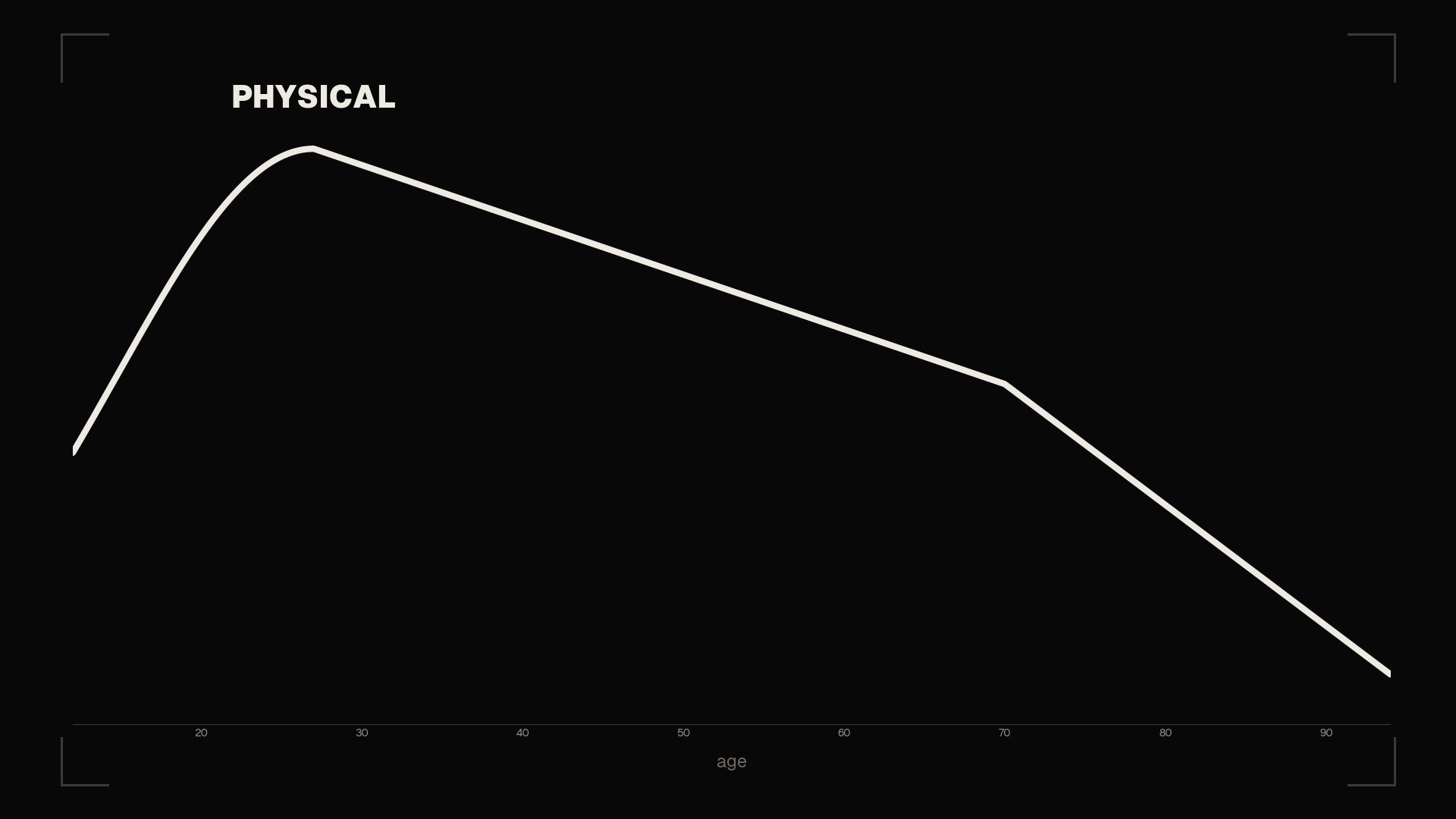
The conversation in fitness has always been about progressing. What do we give people that makes them better at things? James spent years handing individuals tools and learnings and watching them get better, and every one of those cases eventually produced the same set of questions. At what rate does this person improve? What is the timeline? How much room is actually left?
Those questions have answers. Not perfect ones, but real ones, and they hinge on two variables coaches often collapse into one: chronological age and training age. James built the chart as a base support, something that would force a coach to consider both every single time someone sat down in front of them, so the coach could figure out the general possibilities for that specific person.
The purpose is stated plainly, and it is worth reading twice. "So you're not lying to them. You're giving them some truths in it."
Growing, peaking, resisting
The chart splits a life into three phases, and each one is its own long conversation.
Growing. It is all up. Huge amounts of potential for growth, room for improvement in nearly every direction. Carl's shorthand for the shape is a line climbing.
Peaking. The line flattens into something closer to horizontal. You are very close to the top end of your maximum, and you are not making a whole lot of improvement anymore. You are making improvements in point percentages over long periods of time.
Resisting. Here is the part that stops people. In resisting, when it comes down to objective measurement of progress and rate of change over a timeline, there are no improvements made. It is actually a decrease. Carl's word for the shape was entropy, and James agreed with it.
Read as a coach, that is not a grim chart. It is a permission slip. It tells you which conversation you are actually in before you write a single day of programming.
Why putting it on the screen quiets the room
James described the sequence, and it is nearly a script.
The client arrives with the culture already installed in them. "Oh yeah, this is what I'm in. I'm into fitness. So this is what we do." Everything they watch and everything they scroll confirms it.
The coach backs it up. Let's talk about you specifically. What you told me is you have this many years of experience. What you told me is you have this many kids. What you told me is you are this age. And then, let me just put up a human chart here, just to give you an idea of where you may sit. This is general human activity potential.
"And so then what it does, it just like quiets the room between the coach and the client."
That is the whole function. Not to deflate anyone. To move the two of you onto the same set of facts before you start negotiating what happens next. In growing, there is all this room. In peaking, the job is to maximize the gifts you were given plus everything you have already built. In resisting, it is a whole different game.
Two thirty-five-year-olds, two completely different conversations
Carl pushed on the obvious gap in an X axis that only tracks chronological age. What about the thirty-five-year-old whose training age is zero?
That one, James said, is the easy conversation, and it gets answered in an inspiring and positive register. You have a lot of upside. There is a huge amount here. This is exciting. He is candid that some of the ease comes from something more human than the chart itself, the philosophical thread from last week's episode about people carrying an idea of hope inside them. Telling someone there is room gives them something.
The hard one is the thirty-five-year-old who has been doing major physical activity since he was seven.
"Understanding when you're getting close to the top of the mountain, that's not as much fun as being told that there's hope in terms of your future for physical activity."
That conversation requires more education, more care, and more background, and James adds a caution worth keeping. Be very clear before you make statements about the very small percentages of improvement someone can still make, because there have been times he was surprised. "I didn't know you had that little bit of a bump left there, but it was there."
But mostly it is not a physiology conversation at all. It is emotional, and cognitive, and it is about letting go of things. If James had one word for where he was steering it, it is this one: acceptance. That is the destination. Not defeat, not a lowered ceiling. Acceptance, because acceptance settles things and pulls someone out of the loop of but they told me I was supposed to keep going up, and everyone says I should keep going up, and all thirty-three people I follow appear to be going up.
Maximum of what, exactly
Physical potential is not one line, and Carl opened up the fact that it fractures by quality. The fastest someone will ever be is a different question from the strongest they will ever be, which is different again from the most enduring.
Roughly, as the two of them laid it out: speed and power peak young, in the twenty-five range, whether that is a strength-speed lift or a hundred meters. Absolute strength standards, bench and squat and deadlift, sit closer to thirty-five. Endurance, marathon rather than ultra, lands around thirty. Ultra endurance pushes into the forties, mid-forties, and even brushes fifty.
So which curve is the real one? James's answer is that you do not need a stack of thirty separate charts, because there is one variable underneath all of them.
The light bulb
This is the analogy Carl says he steals constantly and always credits. Asked whether he invented it, James said, "Maybe."
The concept is the brain, a light bulb, and central nervous system activity. Carl's explanation of it, which he offered up for James to correct and James did not correct at all, runs like this. Think about wattage going into a bulb. The more power into the bulb, the brighter it burns. Lifting a heavy load requires more power than going out for a six-mile run, so the heavy lift lights the bulb brighter.
That single variable reorganizes the whole age question. High light bulb activities move to the left on the chart, toward younger. Lower light bulb activities move to the right, toward older. Which is exactly why James separates patterns from pacing, and why those two words carry the weight they do in the OPEX vocabulary.
Then it gets more interesting, because brightness is not a property of the activity alone. The same activity across different populations lights the bulb up differently. Carl's image for it is walking into a gym and watching a room full of people do hang power cleans. You can see, immediately, how much power each of them can put into a simple movement. You can see the different levels of the bulb across the room. From there you can discern how fast they are, how powerful, how deep they can dig. And you already know which of them would light up if you put them on the bike and said go hard for fifteen seconds, and which of them would not really do anything at all.
Which leads to the part that changes programming decisions.
"That person shouldn't be doing a tough three. Why? Because their light bulb can't even light up."
All they are doing is three reps at ninety percent of a dim, low-wattage three rep max. The reason to stop is not that anything bad will happen. It is that they are wasting their time.
James added the piece that keeps this from being an insult. Not everyone has the ability to light the bulb really bright, and sometimes that is simply what we were given and how we are made up. He also gave the CrossFit era its due through this lens: the reason he loved being in that world for performance is that it was an attempt to make people do high light bulb activities at an aerobic level. To make weights aerobic. For everyone who got inside it for reasons other than entertainment and attention, he calls that a very admirable undertaking.
Why the eleven-year-old should not have a three rep max
Age plus the light bulb answers a question that otherwise turns into an argument. Why give an eleven-year-old boy a three rep max?
"They actually have no chance of lighting their bulb as bright as possible."
It is not possible, so the exercise is not doing what the adults in the room think it is doing. James called the whole practice a social manufacturing technique placed on the kid, with adult thoughts stacked on top: he is going to light his bulb and get stronger. He cannot. That is the end of the analysis.
Carl, currently living this stage as a parent, brought the version he encounters constantly. Paying a speed coach to run sprints with a ten or eleven-year-old to make them faster. Repeated sixty-yard dashes with the stated intention of producing speed. His read is that it makes no sense, and the light bulb is why he can say it in one beat instead of five. Are they actually lighting their light bulb up? No. They are not.
The eight to twelve window is real, just not for what people sell it as
James then drew the line more precisely, and this is the most immediately usable distinction in the episode.
You absolutely can make major improvements in a kid's ability to get faster between eight and twelve. But the mechanism is not the one being sold. Skill speed work builds it. Maximal speed efforts do not. "If that eleven-year-old's doing the speed work with a coach to get faster, that is stupid. But if that kid wanted to improve the adaptability, the rate of change possibility to come when hormones and mechanics are laid on top of it, yes."
Kids' brains between eight and twelve are sponges. If you are uploading a large volume of skill speed work in that window, you are laying down the possibility of what arrives later. Same correction on the strength side: they should not be chasing absolute strength. They need tension. More tension, more reps of tension, and all of that becomes the substrate for resilience and tendon strength down the line. A kid who does skill acquisition in the speed realm and accumulates tension between eight and twelve has the world in front of him.
Carl connected it to hitting research in baseball, where the window for learning to hit a ball well sits right around nine to twelve. You are not teaching the kid to be more powerful or to raise rotational velocity. You are getting reps in so the brain has a foundation. He is watching it happen in real time with his son Carson, who asked at nine what he needed to do to get good at baseball, got a hitting coach, and over eight months has produced skill acquisition Carl calls unbelievable, to the point where he can nearly hear the ball coming out of the machine. James's addition: the eyes and the sense-making organs sit right next to the brain, and laying that down early matters more than people think.
The second set of lines
Then Carl put up the other chart, the one James teased at the end of last episode, and this is where the episode stops being about fitness.
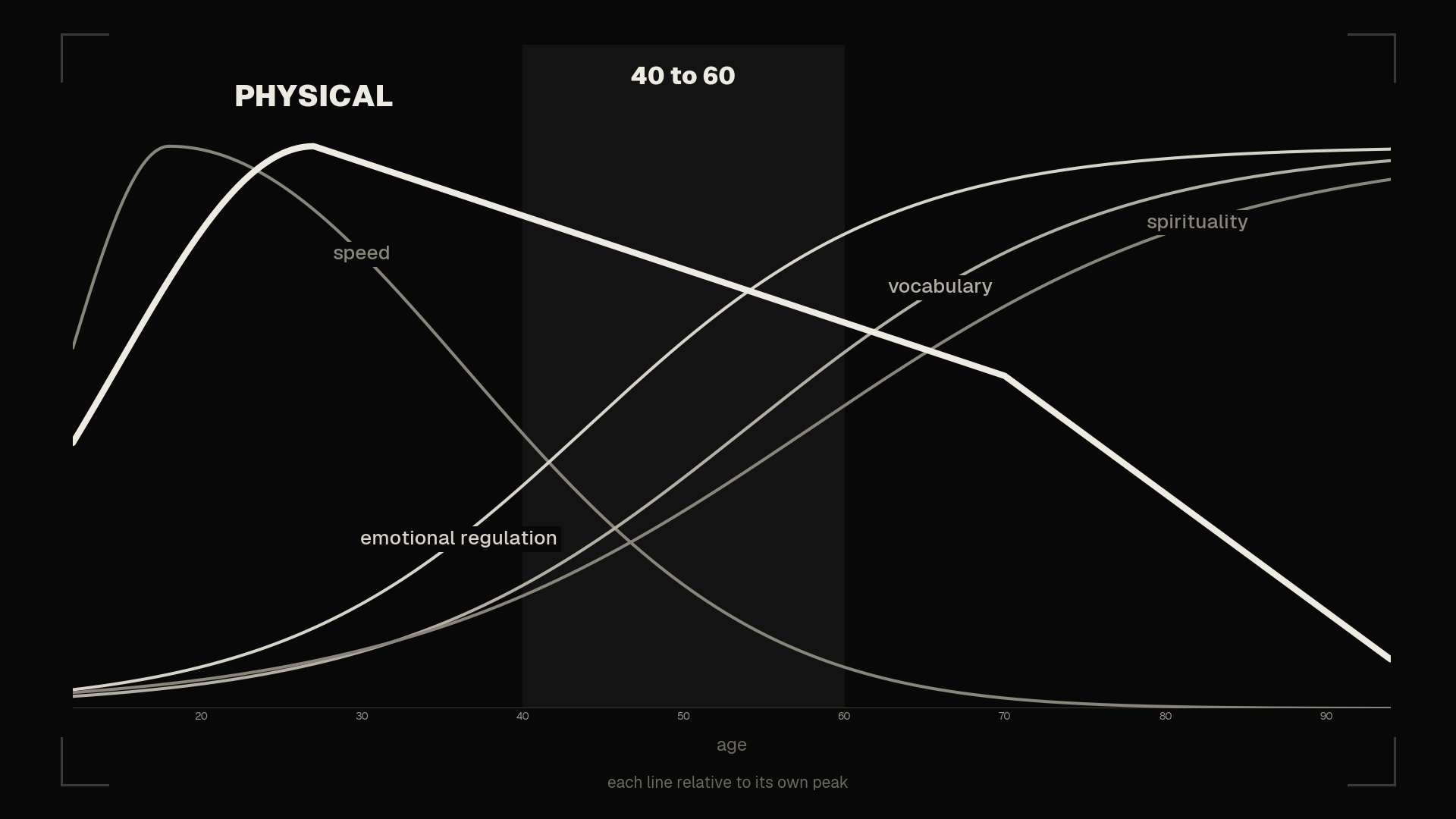
The physical line comes down. What else is on the page? Emotional regulation. Vocabulary. Spirituality. Rate of change and adaptability and the ability to download new capabilities. Things a human can still get better at long after the physical curve has turned over.
James, thinking out loud about where those lines actually sit, went somewhere interesting on emotional regulation. He is not certain it belongs where the chart puts it, because society has a big part to play in it and a great deal has happened in the technological age. He compared a thirty-year-old today to a thirty-year-old in 1940 and what that person carried in terms of security, responsibility, survival, and reproduction, and his instinct is that the 1940 line sits higher.
On spirituality he had no hesitation, and he located exactly where that part of the chart used to land in a room. You could feel it in the crowd, mostly in the three or so people who were fifty-five or older, the ones who would smirk at the idea that there are no improvements left to be made. Everyone else in the room could not understand what they were talking about yet.
Carl banded the interesting stretch between forty and sixty. Not because life stops at sixty, but because that is where most people arrive at the realization that the physical stuff is genuinely withering. They might still be fit. Still moving, still strong. Just not as fit, or as strong, or as powerful as they used to be. And then he put the two charts together and named the actual stake.
If the physical was going down and you had nothing else, it may have felt like everything in your life was going down.
Why James built the second chart
"It's been embedded in my thoughts since I broke my leg."
James does not hide his bias, and he does not want coaches guessing at where it comes from. The reason challenge yourself physically sits at the top of his list is that he experienced a human transformation while not having physicality. At that point you can go one of two directions. The doldrums and the abyss, or a major aha moment that there is more to you than the physical.
It did not diminish physicality for him. It explains where all his energy goes.
"You've got to have something to fall back on when physicality falls apart. You've got to have something."
And it explains the sentence coaches should probably write down. You do not just build better physical humans. You build better humans. You make them resilient enough not merely to complain less after a bad workout, but to know that if they turn an ankle and take two weeks off, it is all good, because now they have a more stable ankle for the future and knowledge about what work and rest actually mean.
His word for what happens when someone holds both the physical and the human in view, on a timeline, is whole. He flagged it as sounding woo-woo and said it anyway. That is when people become whole.
How to actually have the conversation
Carl asked the practical question. When you have to tell the thirty-five-year-old that those days may be behind him, and you want to point at the other opportunities, how do you get there?
James's approach is counterintuitive and worth adopting. He moves the conversation as far away as possible from anything that lets the person personalize it. He wants them thinking big picture and general, so he tells stories, sometimes a specific client anecdote, because then it is not about them but it is still about the thing. Then he reads whether it landed. Did that part get it? No? Try another way.
The example he gave was a woman who still had the itch. He had recently watched a documentary about how older women in Hollywood get pushed out, treated as though they have no part left to play, and he brought the biological parallel to the table. Why would we be built to stop reproducing at a certain age, and go through significant turmoil in the space of a year or two, and get weaker faster, and accumulate more possibility of disease no matter how good the basic lifestyle guidelines were? What kind of setup is that?
He proposed it deliberately, knowing that particular person, and it produced exactly the energy he was hoping for. Not a promise to get stronger. Something more like: you just watch me. My downhill will be very, very short. I will not go into the night quietly.
Then the pivot. Well, this is a reality. So what are you going to do about it? Are you going to tell me you want to improve your CrossFit times in the next six months? How lower-order is that?
For men, the angle usually ran through the armor. Personal pressures, pride, and everything stacked on top of it. What he was after was helping them become really good as a man outside of the bench press.
Two guardrails came with all of it. First, do not let someone leave with only the awareness that the physical is diminishing and consider your job done. Be present with them while they work out what comes next. Second, and this one is firm: you have to leave your own biases about how people should live at the door. You may be right about how a life is best lived. You cannot bring that to the conversation. If they land there on their own, without coercion, that is fantastic.
And the reassuring part for any coach who finds this territory intimidating. It takes very little skill to ask the question. What does purpose mean to you? What is meaning? It takes some skill to carry the conversation afterward, and you build that skill by having it. But asking is nearly free, and there is a real chance nobody has ever asked that person before. James's one condition on it: be curious, and mean it. Clients will sniff out a twenty-two-year-old performing curiosity at a sixty-year-old who is looking into the abyss.
Alignment sits underneath all of it
Then Carl connected it to something that lives at the bottom of the pyramid when OPEX teaches basic lifestyle guidelines, borrowed from James without asking permission first.
Alignment.
Before any prescription, before we need to do this or that, make sure the coach and the client are clearly moving toward the same aim. Then keep reassessing it. Because it is easy to assume you are on the same page and go, and it is easy to talk about sleeping and moving and chewing without ever confirming what those things are in service of.
James's addition flipped the responsibility, and it is the sharpest coaching point in the last stretch of the episode. Everyone assumes alignment is the client's job to maintain, or the coach's job to propose once. But he remembers moments early in relationships that were small indicators things were out of alignment, and he let them go. "So you see, I wasn't consistent on behalf of the relationship."
His example is almost comically small. Sorry, I'll be a couple minutes late. That is nothing, socially. But if the two of you talked at the beginning about professional courtesy and what that means for mutual respect and setting the tone, then it is not nothing, and letting it slide teaches the client something. Maybe the message they were really sending was: is this person going to hold the line? Because I have gotten out of these situations a lot before.
The bigger version is the request that quietly contradicts the last twelve months of work. Hey, I want to work on this. It is very easy to say okay and change the plan, and then three weeks later change it again.
Which is where James got funny and honest at the same time. His most fulfilled, most aligned years of coaching were in the mid-2000s, when a client had no access to the squirrel. Not because he was a militant coach, though he allows that he kind of was. Because the program was all there was. Now it is peptides, drop sets, the Swedish four by four, swimming across a lake, two days later, all the time. He is empathetic to coaches dealing with that and clear that he has no control over it.
What he does have is the answer for it, and it is not a policy. It is a principled attitude. Make people believe in your direction for the program on the strength of principles rather than this is what you could do or this is what I was taught. Do that well enough and they stop asking. They will check with other members of the gym to see whether you bend for anyone else, and the answer comes back that you did not, and that it was not best for them either.
Carl closed the loop on that with receipts. He found a text thread from 2017 where James was furious, seconds after learning that a client had done something he had explicitly told them not to do. They are out of here. Which is one way of confirming that the principled attitude was not a talking point.
Maximum physical potential is one chart, but James is right that a lot of principles live inside it, and Carl is right to call it one of the most important charts OPEX offers CCP coaches. Growing, peaking, resisting tells you which conversation you are in. Training age tells you how much room is left. The light bulb tells you whether the work you are prescribing is doing anything at all. And the second set of lines tells you what to build while the first set comes down.
Which is the whole job, stated the way James states it.
You do not just build better physical humans. You build better humans.
Frameworks is part of the CoachRx Podcast Network, alongside Marketing for Fitness Coaches and Behind The Design. New episodes weekly.
If you want the charts rather than the summary of them, maximum physical potential is one of the frameworks taught inside the OPEX Method Mentorship, the ten-week system for installing the principles behind program design and consultation. The next cohort starts October 13. Book a strategy call with a coaching advisor who has been through the program.
Listen to Episode 47 Now
▶️ Watch on YouTube
🎧 Listen on Spotify
📖 Catch up on past episodes + blog recaps
Have questions?
DM Carl on Instagram @hardwickcarl
Frameworks is part of the CoachRx Podcast Network, your hub for principled, purpose-driven coaching conversations.
For more shows, visit:coachrx.app/podcast-network
Stay ahead of the curve and provide the best for your clients with CoachRx.
