

Will AI Replace Fitness Coaches? The Real Answer
Frameworks with Carl Hardwick | CoachRx Podcast Network
Fitness coaches keep asking me the same thing right now: will AI replace us? My answer is no, not if you're a great coach. But I also don't think we can ignore what's happening and hope our work stays the same.
I see two bad reactions over and over. Some coaches are scared of AI and want nothing to do with it. Others shrug it off like it's a fad. I think both sides miss the point. Coaching is still one of the safer fields, but the way I work, organize, communicate, and make decisions is already changing. So instead of panic or denial, I'm paying attention.
Why I think coaches need to pay attention right now
When I first started talking about AI from a coach's point of view, it was around late 2021 and into 2022. That was the era when ChatGPT became the thing everyone wanted to test. Back then, I thought the next 3, 6, and 12 months would completely flip coaching on its head.
That didn't happen as fast as I expected.
Yes, the tech improved. Yes, there was real value in prompting, brainstorming, and using AI to bring new ideas into my head. Still, for most coaches, it mostly felt like a smart chat tool. Useful, interesting, and sometimes impressive, but not yet something that changed the shape of a business.
That's not where I think we are anymore.
Over the last few months, my thinking has changed a lot. I don't mean I've gone all-in and handed my coaching practice to a machine. I also don't mean I'm trying to scare anyone into thinking their career is over. What I mean is simpler than that. We have to look at the market honestly, see what AI is doing right now, and ask how it fits into our work before other coaches figure that out first.
If I ignore a tool that can give me back hours each week, someone else won't. And if that tool gives them more time for assessment, relationship-building, and better coaching, then they get better while I stay stuck doing admin by hand.
Coaching is still one of the safer jobs in the market, but safe does not mean unchanged.
That idea sits at the center of this whole conversation.
The Anthropic labor market study shows where AI is hitting first
One of the most useful things I've seen lately came from Anthropic. They published a large labor market study, and what stood out to me was the metric they used: observed exposure.
What observed exposure actually means
Most AI talk lives in the future tense. People ask what AI could do, what it might replace, or which jobs seem risky. Anthropic looked at something more grounded. They measured what AI is already doing inside real jobs right now.
That matters because there is a big difference between theory and reality.
In their framework, the blue side represented theoretical exposure, which means where they think AI is likely to affect a job. The red side represented observed exposure, which means how much impact is already showing up in real work.
That gives us a much better lens. It moves the conversation away from sci-fi predictions and toward current market behavior.
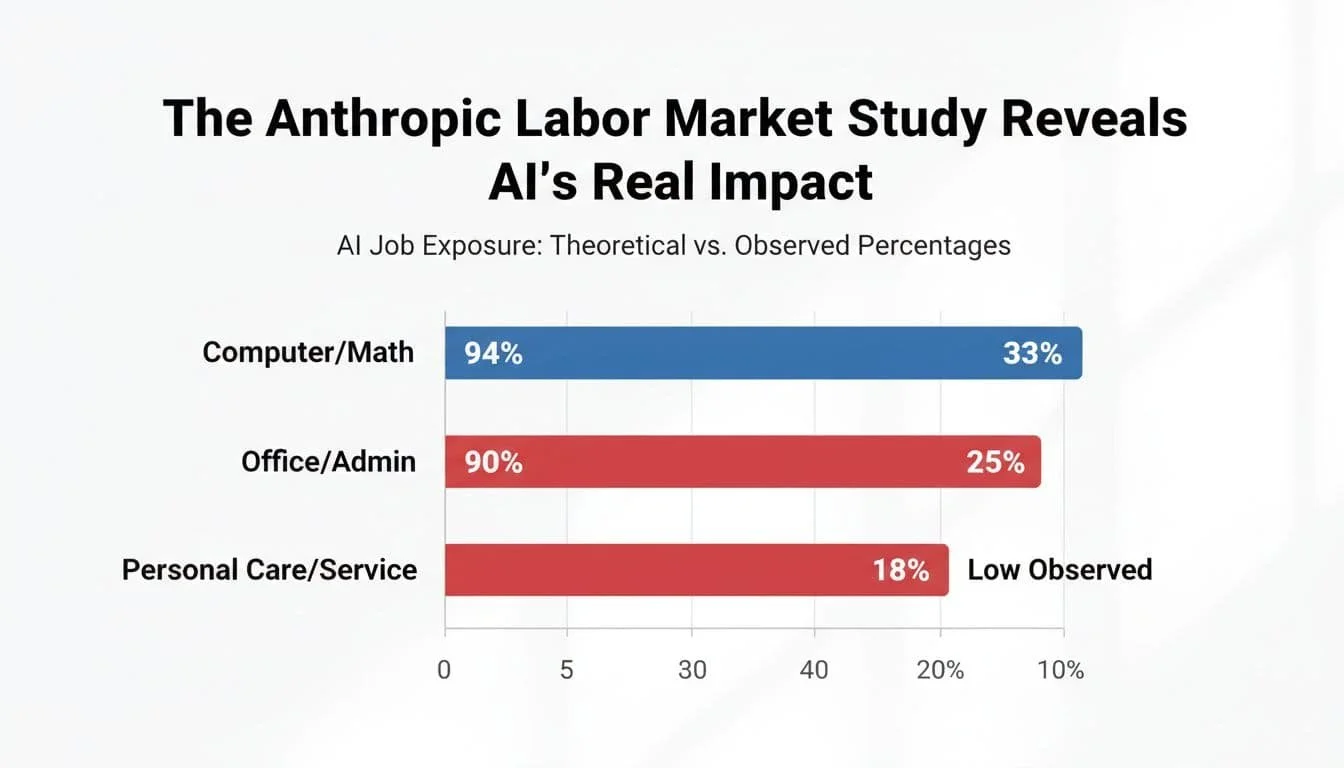
Here is the quick snapshot that shaped my thinking.
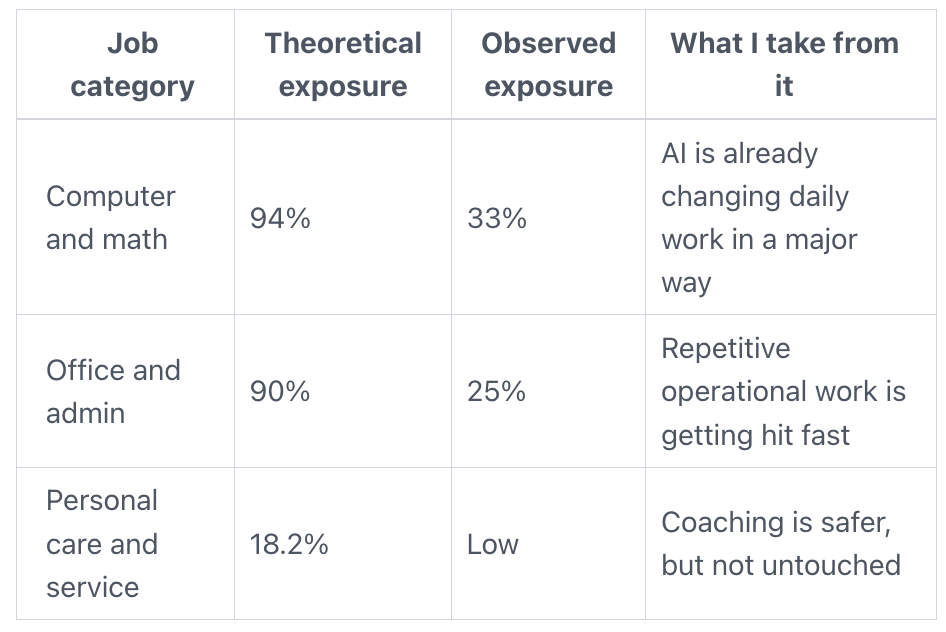
The rest of the chart told a similar story. Business and finance, sales, legal, education and library, and arts and media are all feeling real pressure now. In other words, this isn't just a future problem. It's already happening.
Where fitness coaching sits in that picture
For fitness coaches, trainers, and wellness pros, the category that fits us is personal care and service. In the study, that group came in at 18.2% theoretical exposure, one of the lowest numbers in the whole set.
On top of that, the Bureau of Labor Statistics projects 12% growth for personal care over the next decade. Personally, I think that may even be too low. If more people move away from jobs that look highly exposed to AI, and if human-centered work keeps its value, I can see coaching growing faster than that.
Still, I don't read that number as a free pass.
AI is going to touch every market. Our category just isn't getting hit the same way as office admin, coding, or legal work. That's good news, but it doesn't mean nothing changes. It only means the pressure lands in different places.
Another point from the broader conversation matters here too. There hasn't been a clear wave of unemployment tied directly to exposure since 2022. Younger workers seem more vulnerable. Experienced professionals who learn how to use the tools are often becoming more valuable, not less.
So the bottom line is this: coaching isn't dying. It's growing. But the work around coaching is shifting fast.
We're already past the chatbot phase
As of mid-March 2026, I think a lot of coaches are still reacting to the AI of 2023 and 2024. That's a problem, because the tools have moved on.
A few years ago, AI mostly meant chatbots. You typed in a question, got an answer, and maybe used that answer for ideas, summaries, or rough drafts. Then we moved into assistants, which could follow instructions and complete small tasks, although the results were still limited.
Now we're in a different phase.
What I see now is this progression:
2021 to 2023, chatbots: ask questions, get answers
2024 to 2025, assistants: follow instructions and complete limited tasks
2025 and beyond, co-workers: work beside you, understand context, and help across multiple systems
Next, agents: take action on your behalf, with more or less oversight depending on how you set them up
That third stage is where it gets interesting for coaches.
A co-worker isn't just a better chatbot. It's something that can know your files, learn your context, connect to your tools, and handle recurring tasks. It can work reactively, when I ask it to do something, or more proactively, when I set it up to watch for patterns and report back.
That's a very different thing from typing random prompts into a chat window.
What AI co-workers actually look like in practice
The tool I've been watching most closely here is Claude from Anthropic. They introduced a co-worker mode that feels very different from the old chatbot model.
Why co-workers feel different from chat tools
A co-worker can read files, write documents, draft emails, recap meetings, connect to tools, and even handle scheduled tasks. It starts acting less like a search box and more like someone helping run part of the business.
What makes that possible is context.
Inside that setup, there are things like plugins, skills, and connections. Plugins are role-based layers, such as legal or marketing. Skills are the specific jobs the tool gets better at, like reviewing a contract, matching brand voice, or sorting large amounts of text. Connections pull in data from the places where work is already happening, such as email, a CRM, Notion, or a coaching platform.
For coaches, that's a big shift. Instead of copying and pasting everything into a prompt, I can tell the tool to go look at the systems where my business already lives and come back with something useful.
If you're trying to reduce the mess of juggling multiple coaching tools, CoachRx coaching software is one example of the kind of platform where this sort of connection becomes more useful, because programming, assessment, and client management sit in one place.
Why the market reacted so strongly
When Anthropic launched its co-worker product in January 2026, the market noticed. Within two months, AI co-working tools were tied to a reported $285 billion sell-off in enterprise software stocks.
That reaction tells me something simple. Investors started to realize that software isn't just competing with other software anymore. It's now competing with AI that can sit inside the workflow and do the work itself.
I also pointed to a high-profile warning from the tech world that companies were beginning to replace parts of teams with AI systems. Whether you're a coach or a founder, that kind of signal matters. It shows where decision-makers think this is going.
How I'm using AI inside OPEX and CoachRx
I've been testing these tools inside OPEX and CoachRx in a very hands-on way. I'm using them for research, content planning, business analysis, and communication support.
One example stands out. I had dozens of conversations with coaches about what they liked inside the platform, what frustrated them, and what needed fixing. I used an AI co-worker to sift through those transcripts, pull out the themes, and help me build a game plan with our developers and with Casey, our CTO.
That didn't replace my thinking. It sped it up.
And that's the point that matters most to me. I don't want AI making my judgments for me. I want it doing the heavy sorting so I can spend more time deciding what matters.
The barrier to entry is also low. You don't need a huge budget to start testing this. I spend more because I'm deep in it right now, but a normal coach can start for about $20 a month and get plenty of value.
A real example: the weekly coaching report I asked AI to build
One of the most useful tests I've run so far was a simple weekly coaching report.
I gave the co-worker access to my coaching data and asked it to build a report for the week. The prompt was broad on purpose. I wanted to see what it would notice, where it would go, and what kind of coaching context it could pull together without me hand-feeding every detail.
What came back was more useful than I expected.
Executive summary: It gave me exercise compliance, lifestyle compliance, overall client compliance, and touch points across the week.
High-level takeaways: It flagged clients who were doing great, including Dennis and his 553-day streak, and it also pointed out people who needed attention.
Client-by-client notes: It pulled highlights from individual training weeks and surfaced important details.
Action items: It created priorities for me and even drafted messages I could use inside tasks.
Some of the details were small, but they mattered. It noticed missed work, like Russian kettlebell swings for one client. It pulled training highlights from my own week too, including hitting a target range of 246 to 247 watts on a cyclical piece and a 100-pound weighted neutral-grip pull-up. It even tied my own training back to a broader coaching goal by noting that my sessions also serve as a place to test programming ideas.
That last part caught my attention because it showed how the system was using context, not just data.
I don't think this report is the final best practice for every coach. I'm still testing. Still, it got my brain moving. It made me think about how much time coaches spend hunting for meaning across check-ins, workouts, notes, and tasks, then trying to turn all of that into clean action.
If a tool can do the sorting and the first pass, I get to spend more time on the decision itself.
Four ways I'm thinking about AI inside a coaching practice
When coaches ask me where to start, I usually tell them not to overthink the perfect use case. This is moving too fast for that. By the time I rank every option, I may already want to change the list.
Still, there are four areas that stand out.
Client communication and better context
This is one of the easiest entry points.
I can use AI to draft check-in emails, shape onboarding flows, outline education pieces, or help turn a rough teaching idea into something a client can actually read. It can also package those materials into formats like PDFs, Word docs, or simple web pages.
The key is that I still edit the message.
I don't want AI pretending to be me with a client. I want it helping me start faster and think more clearly. That difference matters. A first draft saves time. A fake relationship costs trust.
Programming support and research
AI can also help on the education and programming side. I can ask it to summarize studies, compare exercise options, help build templates, or turn evidence into plain language for a client.
This is useful because research takes time, and time is usually the thing coaches don't have enough of.
What AI can't do is assess the client for me. I still own that part. But once the assessment is done, the tool can help me translate what I saw into programming notes, progress tracking, and client-facing explanations.
It can even act like an education assistant. For example, I could ask it to surface the top studies I should review each month so I stay current without chasing random topics.
Business operations, which is the easiest win
For most coaches, this is probably the lowest-hanging fruit.
Scheduling, invoicing, email replies, content calendars, financial review, standard operating procedures, and all the repetitive admin around the business can eat up a huge chunk of the week. I've said for a long time that coaches should build systems. What AI adds is the ability to compress a lot of that operational mess without adding another staff member right away.
I still want caution here, especially with money. I wouldn't blindly trust financial tasks without checking the work. But I can clearly see where a coach could cut costs and save time by using AI to assist with the operational side before outsourcing to a human.
Continuing education and consult practice
This might be the most underrated use.
I can feed research papers into the system and ask for plain-language summaries. I can describe client scenarios and explore program options. I can even have AI draft a program that I then review, critique, and improve.
Another smart use is consultation review. If I record a consult with a client's permission, AI can help me review my own performance. It can point out where I rushed, where I missed a question, or where my structure could improve.
That starts to feel less like a chatbot and more like a smart colleague who has access to all the context I choose to give it.
What AI still can't replace in good coaching
I want to be careful with absolute statements here, because a lot of things people once said AI would never do are already being challenged.
A few years ago, I would have been much quicker to say, "AI can't replace thinking," or "AI can't replace relationships." The truth is more complicated now because people do form attachments to machines, and some tasks that looked deeply human now have machine support.
Still, in coaching, there are parts of the job that I believe remain firmly human right now.
Real-time assessment is still human work
AI can't assess a body in real time the way a strong coach can.
It can't watch movement the way I can in the room. It can't feel tissue quality. It can't read the small changes in posture, breathing, facial expression, tension, and energy that shape what I do next. That's years of pattern recognition at work.
Those details often decide whether the right move is to push, pause, scale, or shift the whole session.
Relationship, judgment, and behavior change still matter more than programming
Clients don't stay because I wrote a clever program. They stay because I know them.
I know when something feels off. I remember their daughter's name. I can change a session on the fly because I can tell they're drained before they say a word. That's not just data. That's presence.
The same goes for judgment. The spreadsheet may say a client is ready to progress. The training log may say load should go up. But if I know they just went through a divorce, haven't slept, and look emotionally flat, then my call may be to hold steady.
Data says go. Judgment says wait.
That is real coaching.
Behavior change works the same way. A perfect program means nothing without compliance, and compliance doesn't come from fancy software. It comes from accountability, care, trust, and clear communication.
AI can help me handle the operational complexity of coaching. My job is still to handle the human complexity.
That's the part I never want to lose.
The framework I'm using, and the action plan I'd start with
The framework is simple.
AI handles admin, documents, scheduling, early drafts, data sorting, and other forms of operational work. I handle assessment, relationship, judgment, inspiration, and behavior change. That's the moat. That's the part of coaching I want to protect and sharpen.
If I were starting this week, this is the order I'd follow:
Track my time for one week. I want to know how much time goes to programming, communication, admin, content, and delivery. Many coaches spend 40% to 60% of their week on tasks AI could help with.
Pick one category only. Communication is a simple place to start. Business admin is another strong option.
Try one real task inside an AI tool. Draft a check-in email for a client who missed sessions. Review last month's numbers. Sort client notes into priorities. Give it real work.
Audit the client experience. If AI touches anything client-facing, I need to make sure the experience gets better, not colder.
Triple down on the human side. I want better assessment skills, better consults, and stronger relationships because that is still where great coaching wins.
If you want to build those human skills with more structure, I teach this kind of thinking inside OPEX Method Mentorship. If you want a cleaner place to manage programming, assessments, and client work, CoachRx coaching software is worth a look. And if you want to follow the conversation as I keep testing these tools, you can find me on Instagram at @hardwickcarl.
My final take on AI and fitness coaching
I don't think the future is AI versus coaches. I think it's AI-equipped coaches versus coaches who keep doing every task by hand. Great coaching is still deeply human, but the work around it is changing fast. I'm not handing my practice over to AI, but I'm absolutely learning the tools, because they can give me more time for the part of coaching that matters most.
Listen to Episode 35 Now
▶️ Watch on YouTube
🎧 Listen on Spotify
📖 Catch up on past episodes + blog recaps
Have questions? DM Carl on Instagram @hardwickcarl
Frameworks is part of the CoachRx Podcast Network, your hub for principled, purpose-driven coaching conversations.
For more shows, visit:coachrx.app/podcast-network
Stay ahead of the curve and provide the best for your clients with CoachRx.
