

Why Most Fitness Coaches Go Broke (And How to Fix It)
Frameworks with Carl Hardwick | CoachRx Podcast Network
Most fitness coaches don't burn out because they care too little. They burn out because the business math underneath their work never made sense in the first place.
I see this happen all the time. A coach gets into the industry to help people, pours everything into the work, and then hits a wall because fulfillment doesn't pay bills, create stability, or protect energy.
Once I look at coaching through that lens, the pattern gets a lot easier to understand.
The real reason great coaches quit
A lot of struggling coaches assume they have a coaching problem. In many cases, they don't. They have a business problem.
That's an important difference. I can be excellent at assessments, program design, communication, and client care, but still build a practice that never gives me enough money, margin, or time to stay in the industry for the long haul. Coaching skills alone won't build a sustainable career.
This is where I think the old hierarchy of needs idea fits well. Most coaches want to jump straight to the top. They want meaning, impact, and fulfillment. That's not wrong. It matters. Still, if the basics aren't handled first, the whole thing gets shaky fast.
Before I can worry about fulfillment, I need to know my work supports a real life.
I need to put food on the table.
I need to create financial safety for myself.
I need to create financial safety for my family.
Then I can focus on deeper fulfillment in the work.
When coaches skip that order, they often build a practice around passion alone. That sounds noble, but it creates problems. They undercharge. They take every client. They work odd hours. They say yes to everything. Then they wonder why the career feels heavy instead of sustainable.
The harder truth is this, many common coaching models are flawed from the start if I never stop to run the numbers. So the better move is to set my income goal first, then reverse-engineer the pricing, capacity, and systems needed to support it. Not every coach needs the same revenue target. What matters is knowing my number, then choosing a model that can reach it without breaking me.
The 3-year burnout cycle most coaches fall into
The timeline changes from coach to coach, but the pattern is familiar. Some people hit it in 12 months. Others drag it out for 10 years. Either way, the path often looks the same.
Year 1, the grind feels normal
At the start, I do everything myself. I coach sessions, write programs, answer messages, handle billing, post on social media, and chase new leads. The week gets full fast, often 60 to 70 hours, and the money is still low.
At that stage, I usually accept it because I'm very fulfilled. I'm doing what I wanted to do, so I call it the grind. I tell myself it's part of earning stripes.
That mindset can hide bad business habits. I take every client who walks in. I lower prices because I want confidence more than margin. I focus on being busy instead of being sustainable. It feels productive, but often it's only motion.
Year 2, momentum turns into a trap
Then some traction shows up. I might have 20 to 30 clients. On paper, that looks encouraging. In practice, I start to feel cornered.
I'm busier, but I'm not wealthier. Worse, I notice that at my current rates, I may need 40 or more clients to earn a middle-class income. That's when the panic starts creeping in.
A lot of coaches try to solve that with more coaching volume. They write more programs. They improve consults. They answer more messages. They work harder inside service delivery, while ignoring the real issue.
Common signs show up here:
I feel busier, but my income barely changes.
I keep improving the work, but not the model.
I stay stuck at rates I set when I was desperate.
I spend little time on pricing, acquisition, or retention strategy.
If I brought clients in at $99 a month because I needed a roster, I can get trapped there. The service grows. The workload grows. The math never catches up.
Year 3, burnout starts to cost me
By this point, I either feel crushed by demand or I start losing clients because my energy is gone. The quality of my work can slip. Programs lose sharpness. Follow-up slows down. My brain gets foggy.
That creates another problem. When I'm exhausted, I stop investing in myself. I don't build systems. I don't delegate. I don't clean up my schedule. I don't step back long enough to fix the structure, because all my time goes to surviving the week.
Burnout often looks like a motivation problem from the outside. Most of the time, it's a math problem with emotional fallout.
That cycle repeats for a few main reasons. Sometimes the model is wrong. Sometimes there are no systems. Sometimes nobody ever sat down and did the numbers before the work started.
Here's the bigger point. Great coaches don't usually leave because they stop caring. They leave because caring wasn't enough to support the business.
Breaking down the math behind common coaching models
Once I stop thinking emotionally and start looking at numbers, the picture gets much clearer. Different coaching models create very different lives, even inside the same industry.
Group coaching math gets ugly fast
Let's start with group fitness. A common rate is about $30 per class, or $30 per hour. That sounds normal because a lot of coaches begin there.
Now the math. To earn $50,000 a year at $30 per hour, I need 1,667 paid hours per year. That's about 32 paid coaching hours every week, with no time off.
And that only counts paid time. It does not include setup, cleanup, commute, programming help, admin, or extra tasks around the facility.
So the real week often looks more like 40 to 50 hours. Then taxes and expenses chip away at the top line. That $50,000 can shrink closer to $35,000 to $38,000 in practical take-home terms.
That is a full-time-plus workload for below-average income. For many coaches, that math doesn't work.
Personal training pays more, but the ceiling shows up fast
Now take a personal trainer billing $100 an hour inside a facility, while keeping 60% of that rate. Net pay becomes $60 an hour.
To make $50,000 a year, I need 833 paid sessions. That's around 16 sessions every week, all year. At first, that sounds manageable.
The problem is everything outside the session. I still need time for program writing, follow-up, client messages, consults, admin, and marketing. If the gym isn't feeding me leads, I also need time to go find those clients myself.
So the real schedule becomes 25 to 30 hours a week or more. Only part of that is paid. The rest is unpaid labor that keeps the machine running.
What if I push to 25 sessions a week? At $60 net per session, that's around $78,000 a year before taxes. For some trainers, that feels solid. For others, that's close to the ceiling.
And once I hit that ceiling, more clients don't fix the issue. More sessions mean more hours. More hours mean less margin for anything else. At that point, I'm trading dollars for hours, and the model starts controlling me.
Why the individual design model changes the math
This is where the individual design model stands out. Using the numbers Carl Hardwick used, let's keep the rate conservative at $300 per month per client.
In this model, I might spend 20 to 30 minutes per week on programming for each client, plus another 10 to 15 minutes for check-ins, follow-up, and adjustments. That puts total time at about 30 to 45 minutes per client each week. Call it 40 minutes on average.
The big difference is that much of this work is async. I don't have to be on the gym floor for every minute I earn. If I coach remotely, I can do the work on my own schedule. If I coach in person, I can still create more flexibility than a pure hourly model allows.
Here's the side-by-side math:
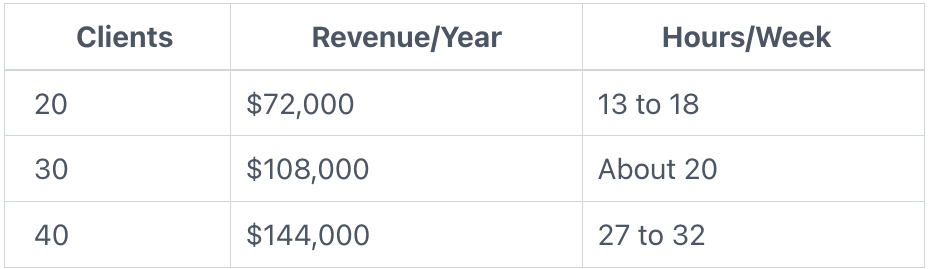
That difference is massive. A group coach may work 45-plus hours for about $50,000 before taxes. A personal trainer may work 25 to 30 hours for about $78,000 before taxes. Meanwhile, an individual design coach can reach about $108,000 at 30 clients while working around 20 hours a week.
Same industry, completely different math. In many cases, it's also a better client experience because the service is built around the person, not the clock.
If I want to test my own numbers, the free Forecast Tool from OPEX is the easiest place to start.
Great coach vs. great business builder
Being a strong coach and building a strong business are not the same skill. I need both.
A great coach thinks about the individual. That's a good thing. I should care about the person's goals, training history, constraints, readiness, and response to the plan. That's the work.
A business builder, though, also thinks about systems and patterns. That means I ask different questions. How does my assessment process work? Where does it repeat well? Where does it get messy? What can I standardize without hurting the client experience?
One of the biggest mistakes I see is hyperpersonalization. That's when I make every piece of the service so custom, so manual, and so one-off that I can't repeat it efficiently.
There's a better middle ground. I want coaching that is highly individualized, not chaotic. The client should understand why they got a certain plan, based on assessment, feedback, and weekly changes. Still, I don't want to recreate the wheel every time I open a laptop.
That means I need repeatable systems for things like:
assessments
program structure
weekly reviews
communication flow
progress checks
The principle is simple. In training, reps matter. Business works the same way. If I do strong reps the same way over and over, I build a system that supports both quality and capacity.
The goal isn't less care. The goal is repeatable care that doesn't depend on me improvising all day.
The accessibility trap that burns out remote coaches
One trap shows up a lot in remote coaching. I start believing that being a great coach means always being available.
Fast replies can feel like good service. Constant access can make clients feel supported. Still, if I don't set boundaries, that same access starts to wreck my schedule.
This is where flexibility can backfire. A loose schedule sounds great until work spreads into every corner of the day. Then I tell myself I'll catch up later, and later never comes.
So I need structure. Not rigid nonsense, but clear rhythm.
I block work by type, such as programming on Wednesday and Friday, check-ins on Tuesday, and consults on Monday and Thursday.
I set response expectations, such as Monday through Friday within 24 business hours.
I use office hours or clear consult windows instead of handling everything on demand.
When I do this well, clients still feel supported. In many cases, they feel more supported because the expectations are clear and the service becomes more consistent. Structure protects the client experience, and it protects me too.
How I would use the business forecasting tool
The forecasting tool from OPEX is simple, which is why it's useful. I don't need a fancy model to start making better decisions. I need a clear one.
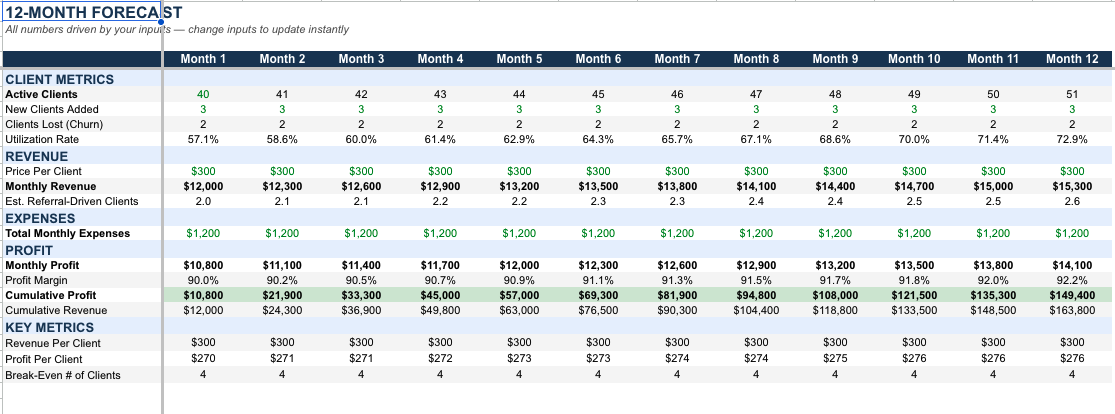
The free business forecast tool from OPEX lets me plug in the core inputs that drive my coaching business. The yellow cells are the main inputs, and once those are filled in, the rest updates.
The key inputs that matter most
The model Hardwick walked through used these kinds of numbers:
40 current clients
$300 average price per client
96% retention rate
3 new clients added per month
70 max client capacity
$1,200 monthly expenses
3% annual price increase
3% annual expense growth
referral rate layered on top of other client growth
With those assumptions, the snapshot looks strong.
Monthly revenue is $12,000. Expenses are $1,200.
Monthly profit is $10,800.
Profit margin is 90%, and utilization sits at 57% because 40 out of 70 slots are filled.
Annual revenue lands at $144,000 if nothing changes.
That alone can be eye-opening. A lot of coaches work hard without ever seeing their numbers laid out this clearly.
Small changes create big outcomes
This is the part I like most. Once I can see the model, I can test levers.
Raise average price from $300 to $325, and annual revenue moves from $144,000 to $156,000.
Raise it to $350, and it moves to $168,000. That extra $50 per client changes the whole picture.
Client count shifts the model too. Move from 40 clients to 55 at the same $300 rate, and annual revenue jumps to $198,000. Reach the 70-client cap, and it reaches $252,000.
Retention might matter most of all. In the example, a 24-month forecast with 96% retention pushed monthly profit from $10,800 in month one to $18,231 by month 24.
But when retention dropped from 96% to 90%, the result got cut almost in half.
That tells me something important. Acquisition matters, but keeping the right clients matters a lot more than many coaches think.
What the forecast can tell me in 12 and 24 months
With the same sample assumptions, the 12-month forecast showed growth from 40 clients to 51 clients. Monthly profit rose from $10,800 to about $14,100 by the end of the year.
Over 24 months, that same business reached $18,231 in monthly profit if the assumptions held.
Of course, forecasts are not promises. Real life will push numbers around. That's why I need to update the model as results come in. Still, the value is clear. Forecasting gives me direction. It shows what one lever can do before I spend six months guessing.
The tool also includes a "Know Your Numbers" view, which gives a current versus forecast snapshot, simple metric explanations, and a break-even analysis. In the sample case, break-even sat at four clients. That's useful because it tells me how much room exists between survival and profit.
What I would do next if I were fixing my coaching business
Most of this becomes powerful only after I apply it. The numbers matter, but only if I use them.
Start with the real numbers
First, I'd download the Forecast Tool and plug in real inputs. Not guesses. Real numbers.
That may mean checking bank statements, software costs, rent, insurance, and actual client count. If my margins look weak, that's not failure. It's clarity.
Audit how my time is spent
Next, I'd track one full week of work. I want to know how much time goes to program design, feedback, floor coaching, consults, admin, and getting new clients.
That step matters because a lot of coaches think they have a pricing problem when they really have a time problem. Others think they need more clients when they mostly need a cleaner workflow.
Run a few honest what-if scenarios
After that, I'd test a few changes in the model. What happens if I raise prices by $50? What happens if I add two clients per month instead of one? What happens if I replace low-paying clients with better-fit clients at a healthier rate?
Those aren't abstract questions. They help me choose the next move based on impact, not emotion.
Pick one change and track it like training
This part is where most people slip. They try five things at once.
I'd pick one change, run it for a month or two, and then reassess. That's how I already coach clients. I assess, prescribe, and re-check. My business deserves the same process.
Clarity beats panic. If the model is broken, I need to fix the model, not simply work harder inside it.
Build a coaching business that can keep you in the industry
The hard truth is that passion can't carry a weak business forever. If the numbers don't work, burnout is often only a matter of time.
The good news is that coaching businesses become far easier to fix once I stop guessing and start measuring. Pricing, retention, capacity, and systems all leave clues. When I pay attention to them, I can build something that supports both my clients and my life.
If I'm serious about staying in coaching, the next move is simple. Run the math, choose a model that fits my goals, and build the business with the same care I bring to program design.
Listen to Episode 37 Now
▶️ Watch on YouTube
🎧 Listen on Spotify
📖 Catch up on past episodes + blog recaps
Have questions? DM Carl on Instagram @hardwickcarl
Frameworks is part of the CoachRx Podcast Network, your hub for principled, purpose-driven coaching conversations.
For more shows, visit:coachrx.app/podcast-network
Stay ahead of the curve and provide the best for your clients with CoachRx.
