Why Specializing Makes You a Better Coach (And Gets You Better Clients)
If you feel like you're doing all the right things but your message still isn't landing, you're not alone. A lot of coaches are "lost in this whole like marketing world," and the default answer becomes, "I coach everyone." In a crowded market, that approach makes it harder to coa
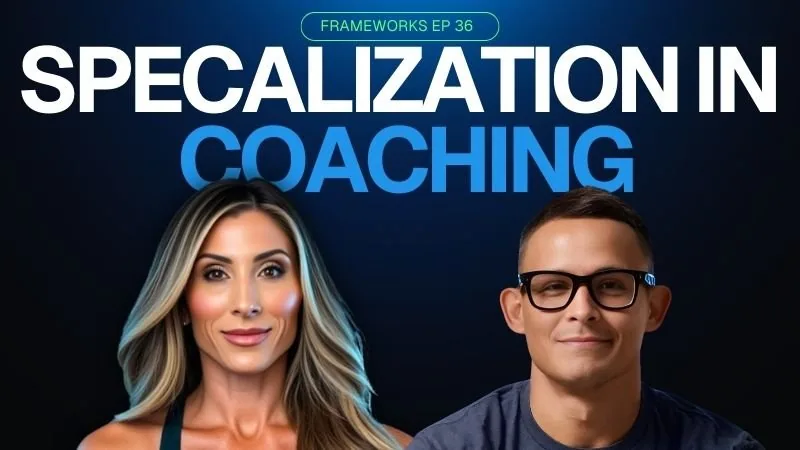

Frameworks with Carl Hardwick | CoachRx Podcast Network
If you feel like you're doing all the right things but your message still isn't landing, you're not alone. A lot of coaches are "lost in this whole like marketing world," and the default answer becomes, "I coach everyone." In a crowded market, that approach makes it harder to coach well, harder to explain what you do, and harder for the right clients to trust you.
Specialization fixes that, not as a marketing trick, but as a coaching decision that improves your reps, your results, and your clarity. Carl Hardwick and Kandace Dickson (host of the Marketing for Fitness Coaches podcast) break it down from both angles, coaching and marketing, with a few practical frameworks you can use right away.
Why specialization matters for coaches right now
Most coaches don't need new marketing hacks. They need a tighter understanding of three things: who they are as a coach, who they serve, and how they deliver the service.
That sounds simple. It also gets skipped all the time because it forces decisions. Decisions can feel risky, especially early on when you're still building confidence and experience. So instead, many coaches hedge. They stay broad, post generic content, and hope the right people find them.
The problem is that the market has changed. There are more coaches than ever, and there's more content than any person can consume. As Kandace points out, the algorithm now rewards content that targets well. It's less about your follower count, and more about whether the content itself clearly matches what someone is looking for.
From a coaching standpoint, specialization creates constraints. That matters because constraints create better reps, and better reps create better outcomes. From a marketing standpoint, specialization makes your message easier to understand, which makes it easier to trust.
To organize the conversation, Carl frames specialization through three connected ideas:
- Mastery needs constraint, you get better when you focus.
- Clarity builds trust, people trust what they can understand.
- Evidence builds authority, results matter more than being "smart" online.
If you want a structured path that reinforces one-to-one coaching, assessment, and delivery standards, Carl references the OPEX ecosystem and mentorship approach. This is the resource they mention: OPEX Method Mentorship (CCP Level 1).
You're not the niche, you're the niche's hero
A common belief in coaching marketing is, "I'm the niche." The idea is that your personality, your lifestyle, and your interests are the brand, so you don't need to pick a focus.
Kandace pushes back on that hard. It can feel freeing, but it's usually a weak strategy when the market is full. People don't wake up hoping to hire a coach with an interesting personality. They wake up thinking about a problem they want solved.
So the better frame is this: you're not the niche, you're the niche's hero.
That shifts the job of your content. Instead of trying to entertain everyone, your content helps the right person see themselves in what you post. Over time, that builds trust. It also lets a potential client "pre-sell" themselves by watching how you think, how you coach, and what you tend to prioritize.
A simple way to define a niche (without getting stuck in demographics)
Kandace offers a clean definition that coaches can use without overcomplicating it. Your niche sits at the overlap of:
- Person: who you coach
- Problem: what they struggle with
- Promise: what your coaching helps them achieve
When those three are clear, your content becomes easier to create because you're not guessing what to post. You're answering the questions that person already has in their head, plus the ones they do not know to ask yet.
This also changes how you think about "targeting." Sometimes the niche is a demographic (midlife women). Other times it's more about psychographics (someone stuck in a cycle of frustration, low confidence, and inconsistency). Either way, the point is the same: pick a person and a problem you can solve, then communicate it consistently.
If you want to see how Kandace thinks about this day to day, her content lives here: Kandace Dickson on Instagram.
Framework 1: mastery requires constraint (in coaching and in delivery)
Carl's first framework is blunt: to become great at something, you need constraint.
He uses an analogy most people understand right away. You won't meet a brain surgeon who is also a great dentist. You also won't meet a great dentist who does reconstructive surgery on the side. Specialization is normal in every serious profession, yet fitness coaches often feel pressure to do everything for everyone.
Fitness coaching has a lot of "products" hidden inside it: group coaching, one-to-one training, templates, rehab, nutrition, lifestyle work, sport prep, strength cycles, endurance, and more. Trying to master all of it at once creates sloppy reps.
Why one-to-one coaching systems create faster improvement
Carl references the OPEX CCP method as a clear example of constraint. The expectation is one-to-one individual design coaching, one coach, one client, designed programming plus lifestyle and nutrition support.
That constraint makes it teachable, but it also makes the coach better faster. When you coach within a consistent model, you can build predictable feedback loops:
- You run the same assessment with every new client.
- You follow a consistent consult structure.
- You deliver the service through a repeatable system.
- You spot problems faster because you've seen the pattern hundreds of times.
A key point here is that specialization does not mean you stop individualizing. It means you stop changing the whole system every time you meet a new person. With fewer moving parts, you can see what's working and what is not.
"To be a master at something there has to be constraint in that thing."
From a marketing angle, this matters because "individual design coaching" is already a separator. Many prospects have tried templates. Many have tried generic plans. If your delivery model is meaningfully different, you can say so with confidence, and clients can feel the difference.
Etching your niche without boxing yourself in
After the model is clear (for example, one-to-one individual design), the next layer is who you want to become great at helping.
Kandace offers a practical prompt: imagine you had 10 consults booked in one day. Which type of person could you talk to 10 times without feeling drained or bored? That answer often points to your best niche, even if you haven't named it yet.
A real example: coaching midlife women through menopause-related friction
A coach on a mentorship call shared that she was already working with several women in midlife dealing with premenopausal and menopausal symptoms. Their friction was not "How do I PR my lifts?" It was more basic and more personal:
Sleep issues, hot flashes, low motivation, feeling weaker than before, and not knowing how to train when hormones feel out of sync. Some had not even started training yet, but they knew resistance training mattered in this phase of life.
This is a clean example of why specificity helps both coaching and marketing.
- From a coaching standpoint, you need deeper skill to serve that person well.
- From a content standpoint, generic performance content will not connect with someone whose main issue is exhaustion and frustration.
Carl and Kandace also clarify something that helps a lot of coaches relax. Not every coach needs the same depth of niche in every context. If you work in-person, have a local pipeline, or coach inside a gym, you can sometimes start broader. However, if you rely on online content for client acquisition, you need the clarity earlier because content has to "do the targeting" for you.
Three things that make a niche feel solid
Carl summarizes "etching your niche" into a few practical filters:
- Interest: you actually care about the problem and want to go deeper.
- Knowledge (or willingness to build it): you have skill, or you will earn it through reps and study.
- Separation: there is a reason you stand out, even if the space is busy.
They also address the fear of saturation. Even if many coaches serve the same market (for example, Hyrox), you can still win by being "better and different" for a well-defined person. As markets mature, sloppy messaging stops working, but clear positioning still works.
If you want your delivery to stay consistent as you grow (assessments, check-ins, progress tracking), a tool like CoachRx coaching software for coaches can help support repeatable systems.
Framework 2: clarity builds trust faster than trying to sound smart
Most coaches agree that clarity matters, yet many avoid it. Carl points to a simple reason: when you're uncertain, you hedge. You keep your options open so you cannot be "wrong."
That's normal early on. Confidence comes from experience. Still, clarity is what creates trust, and trust is what creates conversations with the right clients.
Here's the difference in plain language:
Before the table, here's a quick way to spot clarity in your message.
Vague messageClear message"I coach fitness.""I help midlife women feel strong and capable while navigating menopause.""Online coaching for anyone.""Individual design coaching with training, nutrition, and lifestyle support.""I can help with your goals.""Here's what we'll focus on first, and why it works."
The takeaway is simple: people trust what they can picture. When you're clear, a client can predict what it will be like to work with you. That reduces friction in the sales process because they do not have to guess.
Kandace adds another important layer. Content compounds over time, but it takes time to work. That's why getting to clarity sooner helps. It's similar to investing. The power is not only the effort, it's the time.
They also caution against chasing trends without understanding why you're drawn to them. Hyrox might be popular now, but the deeper interest could be endurance, concurrent training, or goal-driven performance. If you anchor your work to the deeper theme, you keep freedom even as trends shift (Spartan races are a good example of something that was huge, then faded).
Framework 3: authority comes from evidence, not information
Carl makes this non-negotiable: marketing cannot save weak outcomes.
Results are the base of everything. That includes objective results (strength, body composition, performance, consistency) and subjective results (energy, confidence, feeling better). Both matter, but you still need evidence that your coaching moves people forward.
Kandace ties this to modern marketing reality. Information is cheap now. People can ask AI anything. So the value of a coach is not "having facts." It's having perspective, connection, proof.
- Perspective: how you see the problem, what you prioritize, what you believe.
- Connection: the client feels understood, not judged.
- Proof: real outcomes, repeated over time, with real people.
Long-form content helps here because it is harder to fake. When you can speak clearly about a problem, explain your process, and show proof repeatedly, you cut through the trust issues that are common now.
Why specialization makes results more repeatable
There's also a coaching mechanics reason specialization helps. If you change 15 things at once, you do not know what caused the result.
Carl frames this through an individual design lens. Every new client is an N of 1. That's already complex. So do not make it harder by changing your whole approach each time. Keep the assessment consistent. Keep the delivery consistent. Then adjust the variables that matter, based on the individual.
The same principle shows up in marketing. If you change your message, your offer, your platform, and your posting style all in one week, you cannot learn what worked.
Ask yourself: "Am I actually getting results with the people that I'm working with?"
If the answer is no, the move is not denial. It's adjustment. Shift your method, your model, or your delivery, but do it in a controlled way so you can learn.
Using trends the right way (GLP-1s, peptides, and lifestyle coaching)
Kandace gives a current example: GLP-1s and peptides are a big topic right now. Regardless of whether a client uses them, long-term success still depends on behavior, training, nutrition, sleep, and lifestyle support.
That creates an opening for a coach who specializes in coaching the whole person. You do not need to change your identity to talk about a trend. You can apply your principles to the situation and offer a steady voice, backed by process and proof.
Let your niche evolve, but keep the throughline
Near the end of the conversation, Carl shares that his long-term "niche" has been understanding what makes people tick. Training is often the medium, but the work is bigger than sets and reps. That throughline also explains why he cares so much about frameworks, confidence, and decision-making.
Kandace points out something many coaches miss when they judge their early career choices. Clarity often shows up in reverse. You see the throughline after you've put in years of reps.
Carl connects this to a concept he picked up from Arthur Brooks: the "macronutrients" of happiness. For coaching to last, you need:
- Enjoyment: you like the day-to-day work.
- Satisfaction: you feel proud of the outcomes you help create.
- Meaning: the work matters beyond a revenue goal.
That last point is important. If the main goal is "I need a niche so I can make $150,000 next year," you might pick something you cannot sustain. On the other hand, if you pick something you care about, you can build for the long run.
A simple way to find your strengths faster is to ask for feedback. Talk to clients and peers. Ask what stands out about your coaching, what feels different, and where you could improve. Those answers often reveal your best specialization path.
If you want to follow Carl's work and ongoing ideas, here's his main profile: Carl Hardwick on Instagram. The episode also mentions a follow-up watch: Watch the next episode Carl recommends.
Conclusion
Specialization is not about limiting yourself, it's about choosing a focus that makes you better. Constraint improves your coaching reps, clarity helps the right people trust you faster, and results give you evidence you can stand on. Start where you are, learn through experience, then commit to a direction long enough for your systems and your content to compound. The coaches who win long-term are not the loudest, they're the clearest.
Listen to Episode 35 Now
▶️ Watch on YouTube
🎧 Listen on Spotify
📖 Catch up on past episodes + blog recaps
Have questions? DM Carl on Instagram @hardwickcarl
Frameworks is part of the CoachRx Podcast Network, your hub for principled, purpose-driven coaching conversations.
For more shows, visit:coachrx.app/podcast-network
Stay ahead of the curve and provide the best for your clients with CoachRx.

More in Frameworks.
Deliver the coaching
you're capable of.
Try CoachRx free and see what changes when every part of your practice is in the same place.